





Advanced Controls Optimization
Develop and validate control strategies that maximize energy recovery across all engine operating conditions. Simulation-driven development cuts calibration time and speeds deployment of production-ready systems.
Design and optimize waste heat recovery systems with GT-SUITE. Predict performance and reduce prototyping through simulation-driven engineering.
SOLUTION OVERVIEW
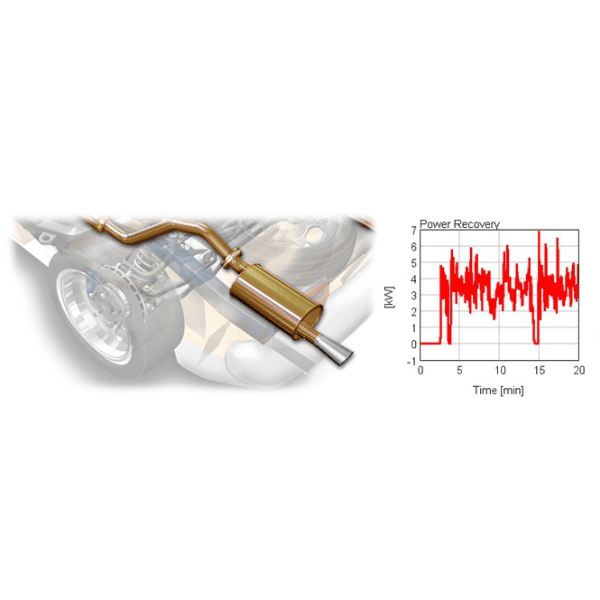
Various technologies are being explored to make use of the hot exhaust gases from engines. Two of these technologies that can be modeled in GT-SUITE are Rankine cycle and TEG (Thermo Electric Generator) systems. These systems can be integrated with a GT-POWER engine model to predict energy recovery across a wide range of operating conditions.
Using GT-SUITE’s proven two-phase approach used in modeling air conditioning systems with fluid properties from NIST Refprop, Rankine cycle models are simulated to explore fuel savings and investigate advanced control strategies. Complex layouts including multiple heat exchanger stages and valving systems are supported.
Studies using TEGs include investigating new advanced Peltier-effect materials and different layouts for maximizing the amount of power generation between the hot and cold streams. Companies using GT-SUITE can reduce physical testing by finding optimal designs in simulation instead of trail-and-error testing.
APPLICATION HIGHLIGHTS

ADVANCED FEATURES
Model, analyze, and optimize waste heat recovery systems with advanced simulation tools that capture component behavior, system interactions, and real-world operating conditions.
Develop and validate control strategies that maximize energy recovery across all engine operating conditions. Simulation-driven development cuts calibration time and speeds deployment of production-ready systems.
Connect WHR models directly to existing GT-POWER engine circuits to capture full engine and recovery system interaction. Predict fuel savings and system-level performance accurately, without rebuilding models from scratch.
Quantify how heat exchanger geometry changes, including scaling for different system sizes, affect performance without new test data. Supports rapid design iteration and early component selection.
GT-SUITE models the full recovery cycle in detail, capturing how the working fluid heats, vaporizes, and cools through the system. From quick concept studies to detailed performance checks, results reflect real-world behavior and give you confidence before hardware is built.
Evaluate and compare WHR system architectures, including complex layouts with multiple heat exchanger stages and valving, to identify the best-performing configuration for your application. Find optimal designs in simulation and reduce costly physical prototyping.
GT-SUITE supports a wide range of refrigerants and working fluids out of the box, and accepts custom supplier fluid data files automatically, with no conversion or setup required. Work with the exact fluids your system uses from day one.
Answers to common waste heat recovery simulation questions.
GT-SUITE works with a wide range of waste heat recovery setups, not just one specific type. Whether your system uses an Organic Rankine Cycle, a steam-based cycle, or a thermoelectric generator, you can model and compare them all in one place. This saves time and makes it easier to find the best solution for your application.
No rebuilding required. Your existing GT-POWER engine model connects directly to the WHR system model, so the work you have already done is preserved. This means you can start studying how your engine and recovery system work together almost immediately.
GT-SUITE supports a wide range of fluids out of the box, including common refrigerants and natural options like CO2. If your supplier has provided custom fluid data files, those are accepted automatically — no manual conversion or extra steps needed. You can get straight to the analysis without worrying about fluid compatibility.
It is useful from day one. Early in the project, you can use it to compare different system layouts and identify the most promising direction before committing to a design. Later, the same model is used to fine-tune performance, develop controls, and validate fuel savings — so your work builds on itself throughout the entire project.