








Electrochemical Materials Database
GT-AutoLion includes a comprehensive, ready-to-use electrochemical materials database, giving engineers immediate access to validated cell chemistries without extensive laboratory testing.
Physics-based battery simulation from individual cell to full pack. Predict voltage, thermal behavior, and long-term aging with GT-SUITE and GT-AutoLion.
Solution Overview
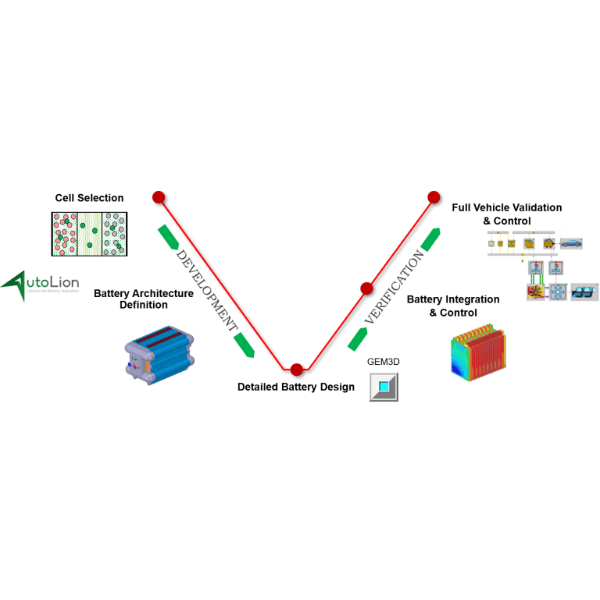
Battery systems sit at the center of every electrified vehicle program, and the decisions made during early design directly affect range, thermal safety, and pack longevity. GT-SUITE provides a complete battery modeling environment that spans from individual cell electrochemistry to full pack integration, giving engineers the fidelity they need at each stage of development. Engineers can work with electrical-equivalent circuit models for fast, system-level studies, or deploy GT-AutoLion to simulate the electrochemical processes inside lithium-ion cells with physics-based accuracy. Both approaches connect directly to thermal and fluid flow models, so temperature distribution, heat dissipation, and cooling system performance are evaluated within a single simulation environment rather than across disconnected tools. GT-AutoLion extends this capability further by predicting battery aging, including calendar and cycle degradation, under realistic operating conditions. A built-in electrochemical materials database reduces the need for extensive laboratory characterization, accelerating model setup without sacrificing predictive accuracy. The result is a modeling framework that supports pack sizing, thermal management validation, degradation prediction, and battery management system development within one integrated workflow.
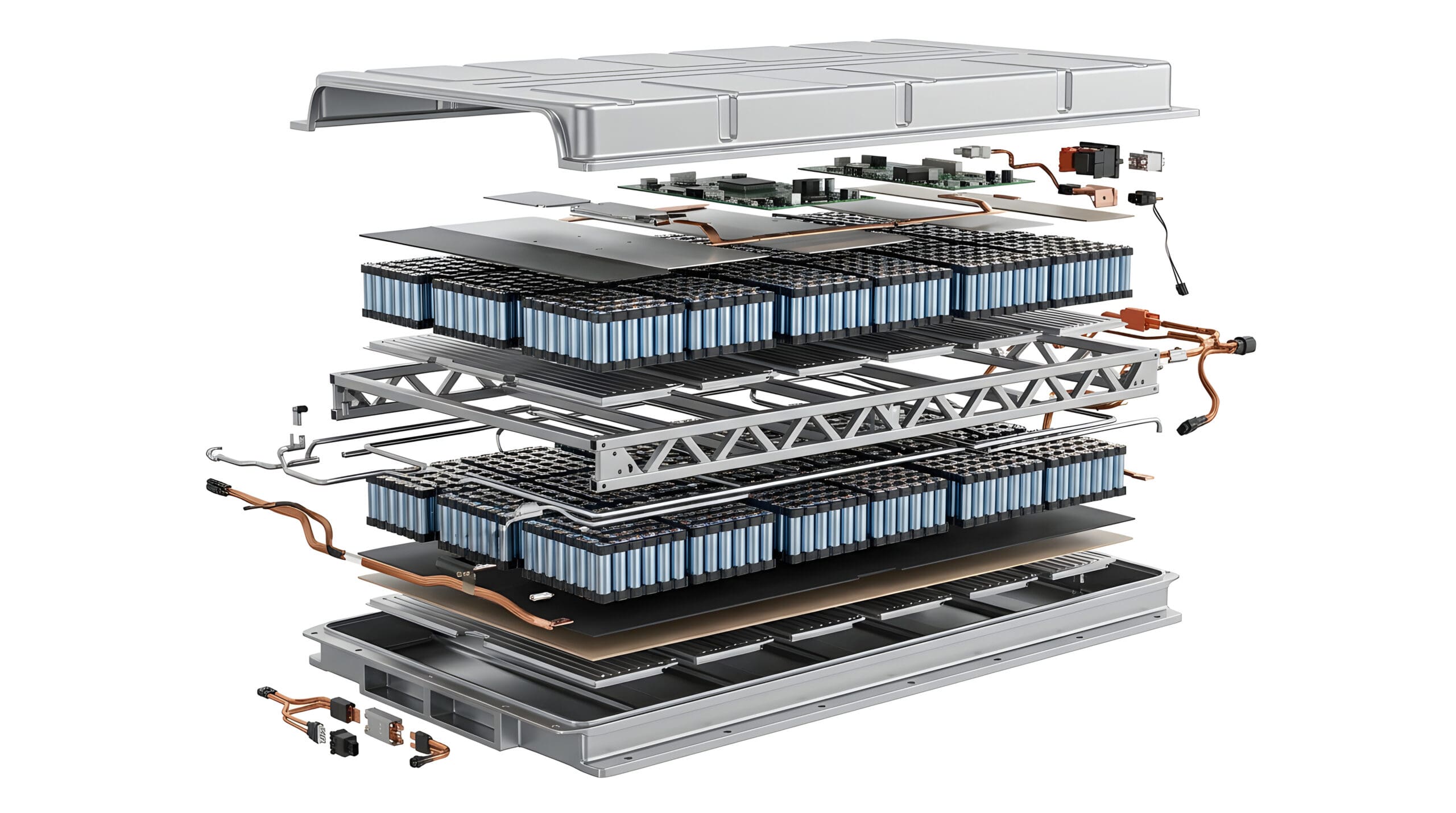
GT-SUITE provides the ideal platform for optimizing battery thermal management and battery cooling systems. In GT-SUITE batteries are optimized on the cell, module, and pack level. Key characteristics are studied such as temperature and current distribution, taking into account both electrical and thermal domains. These battery models are integrated with other systems to capture the transient effects on terminal voltage, terminal power, heat dissipation rate, average state of charge, and more.
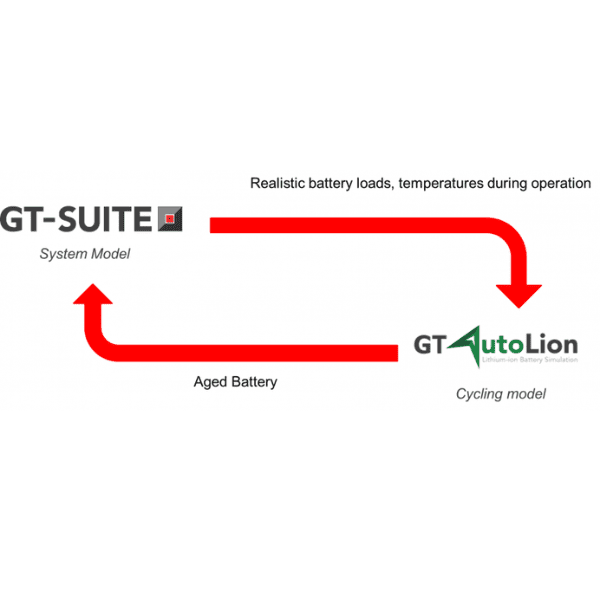
GT-AutoLion, the industry-leading Lithium-ion battery simulation software, predictively models the electrochemical processes within Lithium-ion batteries. Included with every installation of GT-AutoLion is a comprehensive electrochemical materials database, reducing the burden for laboratory testing of electrochemical properties. GT-AutoLion empowers engineers to predictively model battery aging phenomenon as part of an integrated simulation.
Application Highlights
Advanced Features
Predict battery range, temperature distribution, and degradation in a unified simulation environment.
GT-AutoLion includes a comprehensive, ready-to-use electrochemical materials database, giving engineers immediate access to validated cell chemistries without extensive laboratory testing.
Engineers can calibrate electrical-equivalent and electrochemical battery models against experimental test data, including capacity fade and resistance growth, to ensure simulation results reflect real-world cell behavior.
GT-AutoLion predicts calendar and cycle degradation using physics-based aging models that can be calibrated to available data and then extrapolated beyond the test range, reducing the need for long-duration physical testing.
GT-AutoLion couples electrochemical, thermal, and mechanical models to predict particle-level stress, strain evolution, and spatial deformation throughout the battery lifecycle, providing insight that electrical testing alone cannot deliver.
Physics-based battery models support the development and validation of BMS algorithms for SOC estimation, SOH tracking, cell balancing, and thermal protection, with direct deployment paths to MiL, SiL, and HiL environments.
Electrical-equivalent and electrochemical battery models couple directly to thermo-fluid system models, enabling engineers to simulate thermal runaway propagation and evaluate cooling strategies at both the cell and pack level.
Explore frequently asked questions about GT-SUITE battery modeling capabilities.
GT-SUITE supports both electrical equivalent circuit models and full electrochemical models through GT-AutoLion. Equivalent circuit models are well-suited for system-level studies such as EV range prediction and thermal management optimization, while GT-AutoLion is the right choice when you need predictive accuracy — for aging studies, thermal runaway analysis, or next-generation cell chemistries. The two approaches can also be used together within the same simulation environment.
Yes. GT-AutoLion includes physics-based aging models that capture mechanisms such as SEI layer growth, active material isolation, electrolyte dry-out, and lithium plating. These high-fidelity virtual simulations are designed to replace lengthy and costly physical aging tests while still reflecting real-world load profiles and temperature conditions. Aged-cell performance data can then be fed directly into full vehicle or device simulations in GT-SUITE.
GT-SUITE allows battery models to be discretized at any level — from a single pack representation down to individual cells — enabling engineers to study temperature, current, and state-of-charge distribution across the entire system. Thermal modeling options range from lumped mass approaches to detailed 2D and 3D finite element models using the GT-SUITE General Thermal Library. These thermal models integrate directly with electrical and fluid flow domains to capture transient behavior under realistic operating conditions.
GT-AutoLion electrochemical models integrate seamlessly with GT-SUITE system-level simulations, including hybrid and electric vehicle drive cycles, aerospace flight cycles, and marine operational profiles. This means battery performance, aging, and thermal behavior are evaluated in the context of the full system — not in isolation.