







Parameter Sensitivity Analysis
Perform sensitivity analysis by modifying the GT-SUITE model parameters from your development environment.
Integrate physics-based GT-SUITE plant models across MiL, SiL, and HiL environments for virtual calibration, validation, and real-time controls testing.
Solution Overview
GT-SUITE can be supplied as an external model via Simulink S-function and/or FMI standard. This way GT models are easily integrated into Simulink control system models for desktop simulation. GT-SUITE supports both running as the Lead and as the Follower software with controls or other CAE modeling tools.
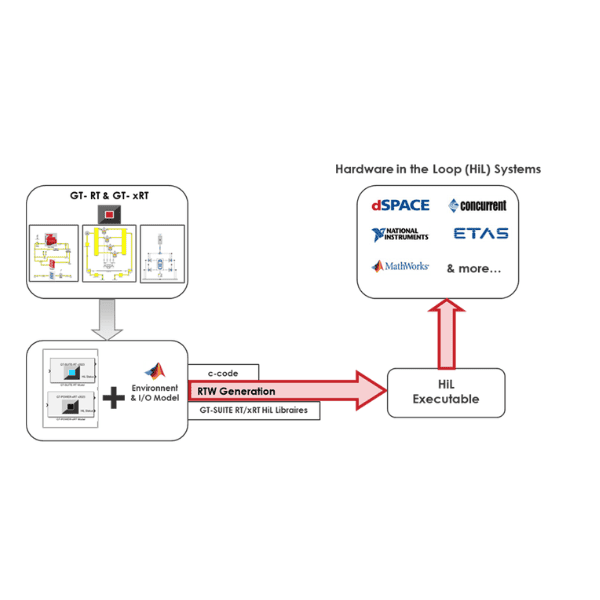
For moving to HiL based environments, GT models are quickly and semi-automatically converted to real time capable fast running or reduced order models (FRM, ROM), and ported to popular HiL systems.
To run physical, predictive engine models on a HiL system, GT offers GT-POWER-xRT, a solution dedicated to the current and future requirements of high-speed ECUs.
Using the same governing equations as GT-POWER, GT-POWER-xRT has been tailored specifically for the needs of ECU calibration and testing, providing unparalleled execution speed, thus allowing for increased model complexity on the test bench. Advanced control strategies, such as combustion control, can now be tested with a detailed physical engine model at significantly faster computation speeds with minimum effort and maximum accuracy, predictiveness, and fidelity.
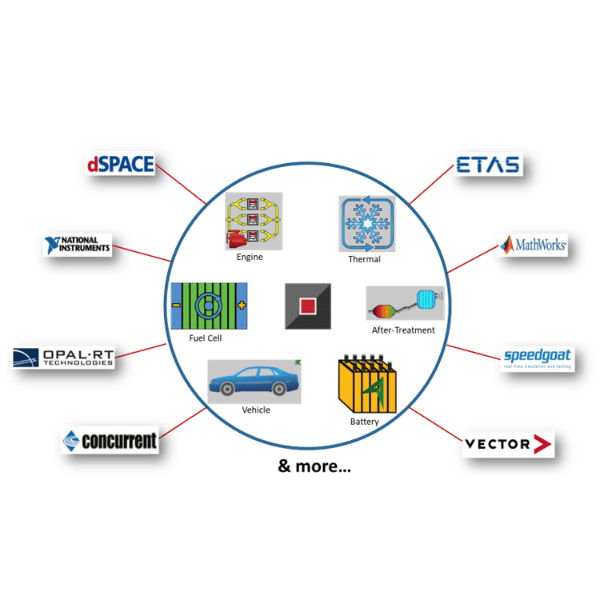
Under the same principle, GT-SUITE-RT can support non-engine applications such as electric vehicle applications (EV), Thermal management simulation, Battery management simulations for controls calibration or aftertreatment real-time simulation for real driving emissions prediction.

Application Highlights

Improve testing efficiency and model accuracy with integrated validation, debugging, and real-time simulation features.
Perform sensitivity analysis by modifying the GT-SUITE model parameters from your development environment.
Model debugging capability through optional logging even on the HiL system.
Modify entire plant model maps from the Controls environment.
Allowing easy transfer of ECU signals inside the GT-SUITE environment.
Quick case sweeps for Hardware in the Loop (HiL) testing accelerating software and hardware validation.
Support of multi-core HiL systems.
Get answers to common questions about Control, MiL, SiL, and HiL simulation, testing, and validation.
GT-SUITE models are semi-automatically converted for real-time deployment, minimizing manual effort. For MiL and SiL, the baseline engine geometry can remain unchanged. HiL systems require some model simplification due to hardware constraints and hard real-time criteria, but GT-POWER-xRT is specifically designed to streamline this process with maximum accuracy and fidelity retained.
GT-SUITE supports all major HiL platforms, including dSPACE, ETAS, National Instruments, Vector, and OPAL-RT. Models are ported to these platforms through a structured conversion workflow, and GT-POWER-xRT provides the execution speed required to meet hard real-time criteria on each of them.
GT-POWER-xRT supports the Universal Measurement and Calibration Protocol (XCP) through XCPHarness, enabling direct connection with INCA and similar calibration environments. This allows GT models to function as virtual sensors for ECU development, dynamometer testing, in-vehicle validation, and race track applications without requiring intermediate tools.
GT-POWER-xRT delivers all common engine performance quantities as real-time signals, including instantaneous brake torque, cylinder pressure, IMEP, volumetric efficiency, and combustion burn points. Cycle-averaged quantities can be derived using built-in control parts, and it is recommended to perform signal averaging within the xRT model itself to avoid aliasing when the model is used as a plant model.