







Precision Thermal Analysis
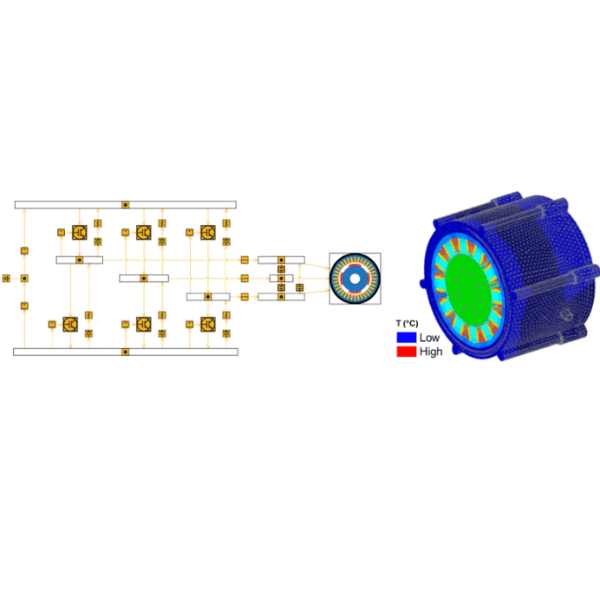
Accurately predict heat distribution across rotors, stators, magnets, and windings to prevent failures and extend machine life.
GT-SUITE contains a rich library of solutions for simulating and optimizing both DC and AC electric machines and their drives
Solution Overview
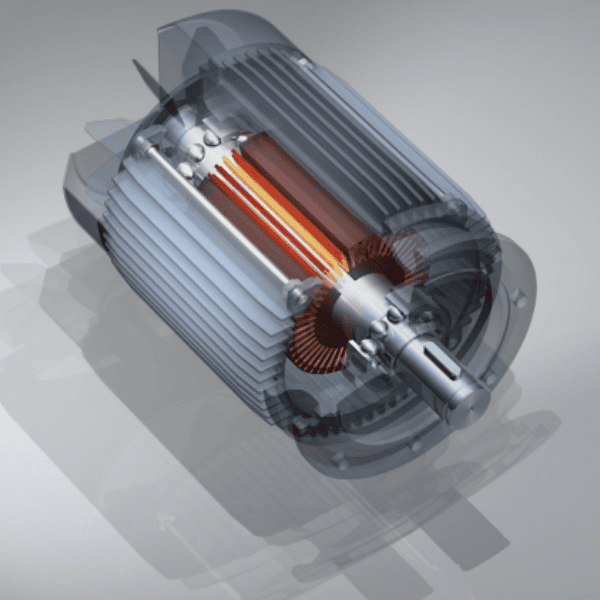
GT-SUITE gives engineers a complete environment for simulating DC and AC electric machines and their drives. The platform supports multiple levels of model fidelity, so teams can match simulation depth to the task at hand. Fast, map-based efficiency models serve vehicle energy management studies, while higher-fidelity configurations support detailed thermal analysis, machine control, and NVH investigations.
A full library of electrical components and transistors drives the machines accurately, and thermal engineers can build detailed rotor, stator, winding, and magnet models within the same environment.
Application Highlights
Advanced Features
Purpose-built tools for thermal, cooling, control, and NVH analysis of electric machines, all within a unified GT-SUITE environment.
Accurately predict heat distribution across rotors, stators, magnets, and windings to prevent failures and extend machine life.
Evaluate oil, water jacket, and indirect rotor cooling strategies to find the optimal thermal management solution faster.
Simulate advanced control strategies, including MTPA, Field Weakening, and SVPWM, for accurate real-world machine performance prediction.
Import JMAG-RT models to identify and reduce torsional vibration and noise at the system level.
Move from fast map-based models to high-fidelity co-simulation with leading 3D electromagnetics tools, then build detailed 1D or 3D thermal models through GT's GEM3D-based process.
Evaluate conceptual motor design for efficiency and heat generation with embedded JMAG Express Online integration, backed by an efficient electrical solver built for large, vehicle-level system problems.
Common Questions on Electric Machines and Drives
The platform covers the full range, from fast map-based models that work well for vehicle energy management and performance studies, up to detailed physics-based models for thermal and electromagnetic analysis. Engineers can pick whichever fidelity fits their current design stage and simulation goal, all within the same tool and workflow.
There’s a mature 3D CAD-based workflow in GEM3D for building high-fidelity thermal models, either in 1D or 3D. Teams can evaluate different cooling strategies, including direct oil cooling, indirect rotor cooling, and water jacket cooling, by breaking the motor structure into thermal masses or finite elements to get accurate temperature predictions across the rotor, stator, magnets, and windings.
Yes. It comes with a full library of electrical components and transistors for driving these machines, and the v2026 release adds a dedicated PWM template that makes it much easier to set up different 3-phase inverter modulation strategies. Control methods like MTPA, Field Weakening, and SVPWM are also built in, so you get realistic motor behavior under closed-loop control.
It supports co-simulation with leading 3D electromagnetics tools, with embedded access to JMAG Express Online for early-stage conceptual motor design, plus the ability to import JMAG-RT models for NVH and torsional vibration work. GT-FEMAG takes this a step further, offering finite element based electromagnetic and structural analysis, and now includes a GT-FEMAG-Designer interface for faster motor design iteration.