






Advanced Spring Dynamics
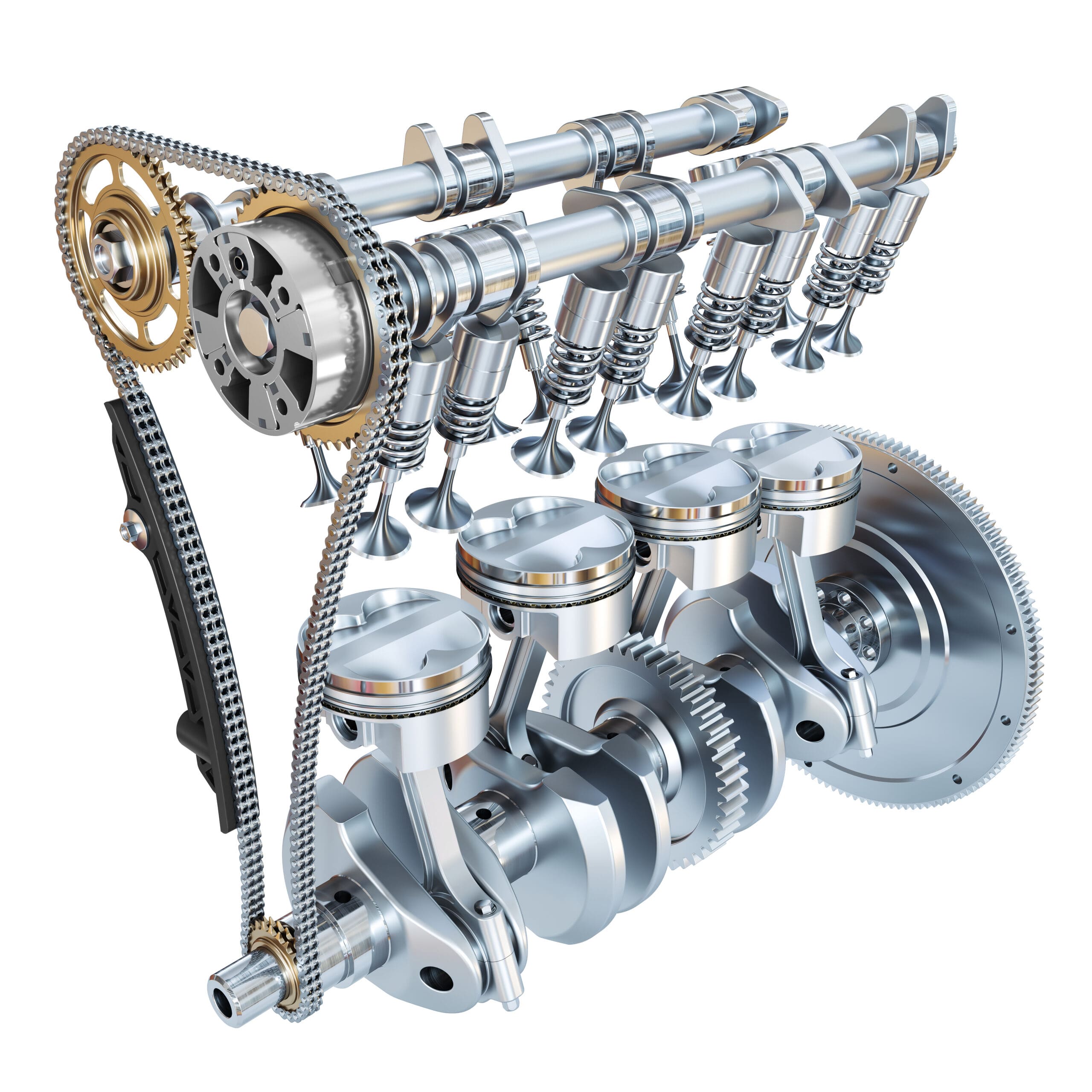
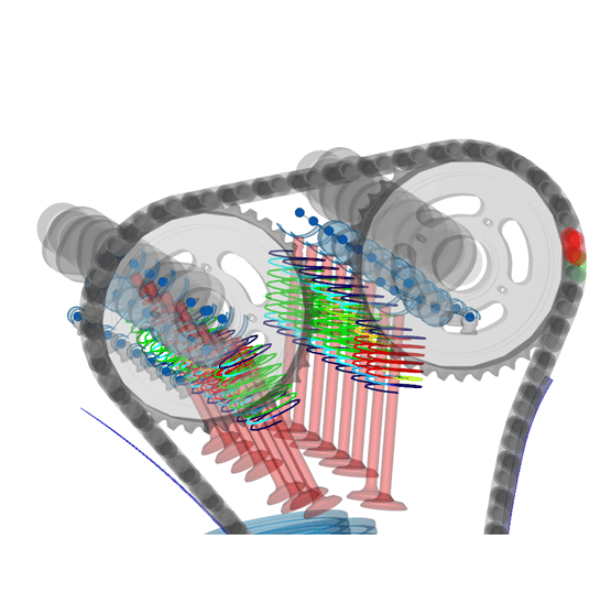
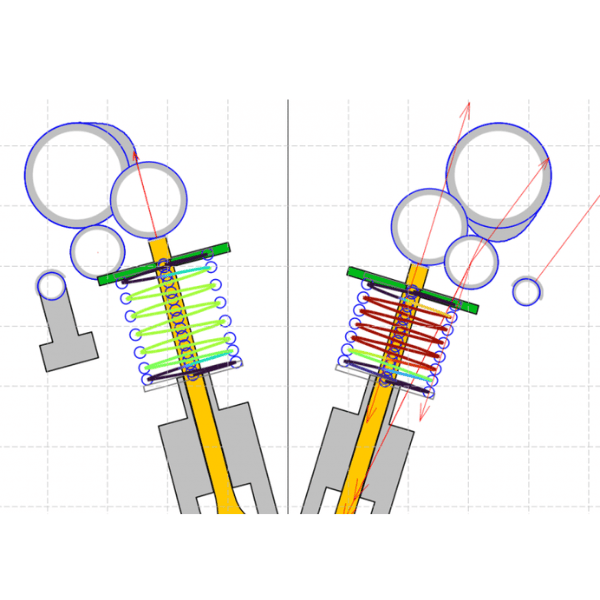
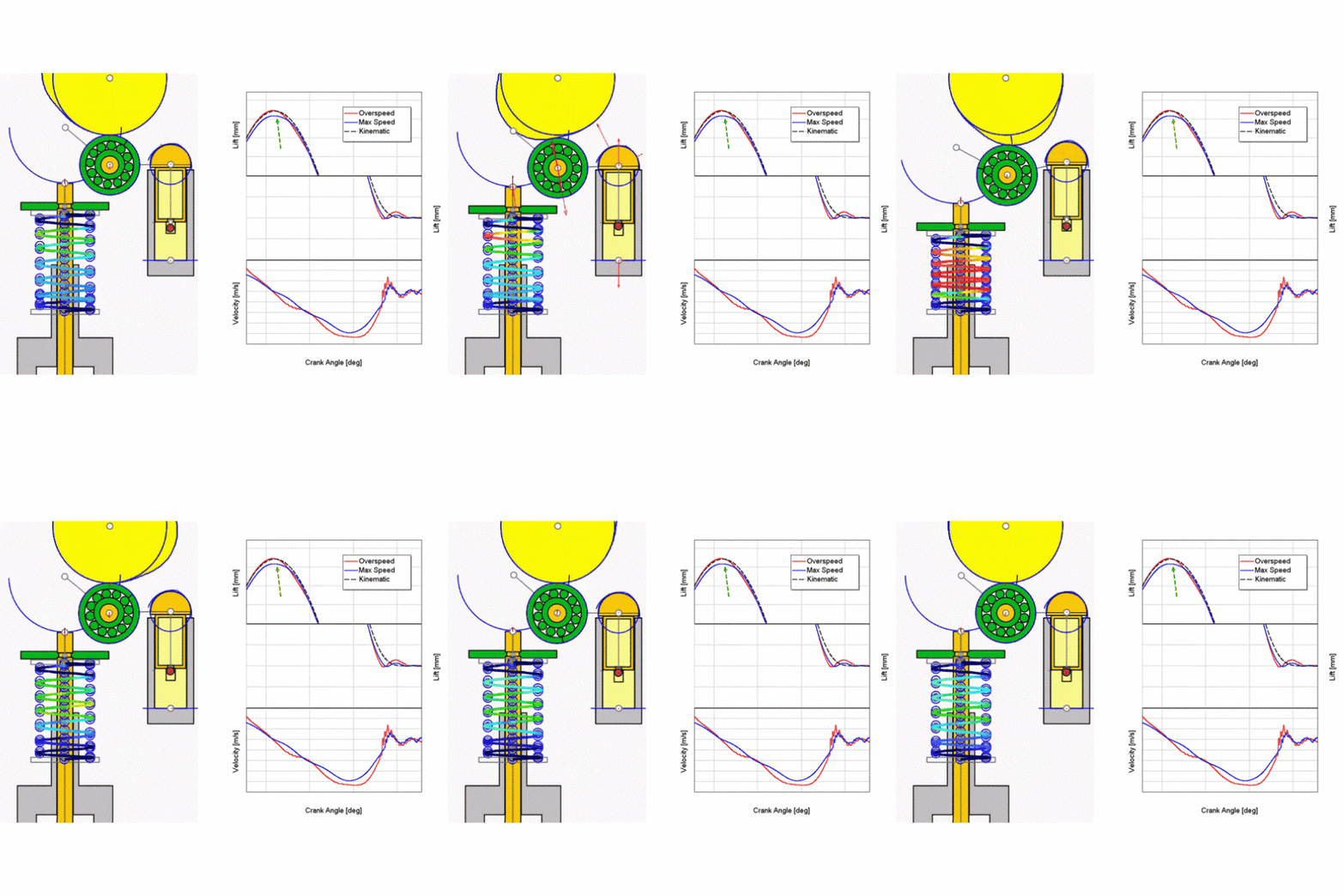
Spring dynamics with distributed mass, stiffness and coil contact.
GT-SUITE provides many tools to the valvetrain engineer, from single valvetrain layout and kinematics to full multi-cylinder camshaft dynamics
Solution Overview
Contact stress, spring fatigue, and friction can be analyzed at multiple levels of fidelity. What sets GT-SUITE apart is the ability to quickly scale the scope of the model as needed.
Since the camshaft model is built from the same building blocks as the crankshaft, that means bearing, torsional and bending analysis is built in. Flexible finite element bodies can be added to replace rocker arms or swing cams. Mechanical valves can even natively link to engine flow valves in a one-step process.
Application Highlights
Advanced Features
Comprehensive capabilities for valvetrain modeling, dynamic analysis, and design optimization.
Spring dynamics with distributed mass, stiffness and coil contact.
Tribology and Friction: Hertz stress, deformation, oil film thickness, and wear at contacts.
Hydraulics: lash adjusters, cam phasers, hydraulic valve actuation.
Import reduced flexible body models from commercial FEA tools.
Transition elements for mixed 2-D/3-D modeling.
Multiple ODE integrators for fast runtime.
Common questions about valvetrain analysis, data requirements, and cam design in GT-SUITE.
GT-SUITE supports four levels of analysis, kinematic, quasi-dynamic, rigid multi body dynamic, and full flexible multi body dynamic, so you can match simulation fidelity to your actual engineering need. A concept stage cam design typically starts with kinematics, while detailed spring fatigue, Hertz contact stress, or camshaft bending investigations call for higher fidelity models. The architecture is designed so you can scale up without rebuilding from scratch.
At minimum, a cam or valve lift profile along with basic valvetrain geometry, component dimensions, contact radii, and lash, is enough to run a kinematic analysis. Moving toward quasi-dynamic or full multi-body analysis will require component masses, spring specifications, and tribological properties like oil data and surface friction coefficients. If material properties are known, GT-SUITE can estimate certain stiffness values internally, which helps reduce the data burden early in the design process.
The valvetrain model integrates directly with GT-SUITE’s engine performance, cranktrain, timing drive, lubrication, and bearing modules, all within a single simulation environment. Mechanical valves can be natively linked to engine flow valves in one step, and cylinder pressure loads can be applied directly to the valve assembly. As a result, valvetrain behavior gets evaluated under realistic operating conditions rather than simplified boundary assumptions.
GT-SUITE includes dedicated cam design tools that support multi-polynomial and hybrid polynomial-spline lift curve synthesis, giving engineers precise control over cam profile shape and its derivatives. Both conventional and variable lift mechanisms are supported, including a general kinematics library for non-standard configurations. Profile synthesis and downstream dynamic analysis happen in the same environment, so design iterations feed directly into performance validation without moving data between separate tools.