Solutions

Powertrain Cooling

Predict heat rejection, model thermal balance, and analyze warm-up behavior, all before physical hardware is required.

Predictive Thermal Modeling

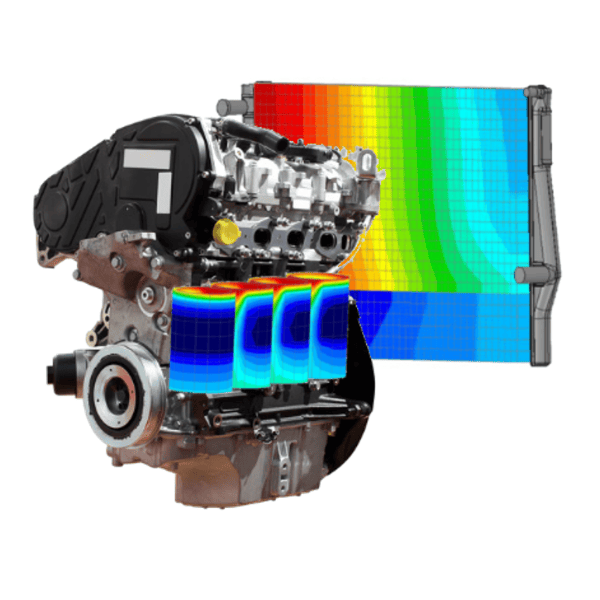
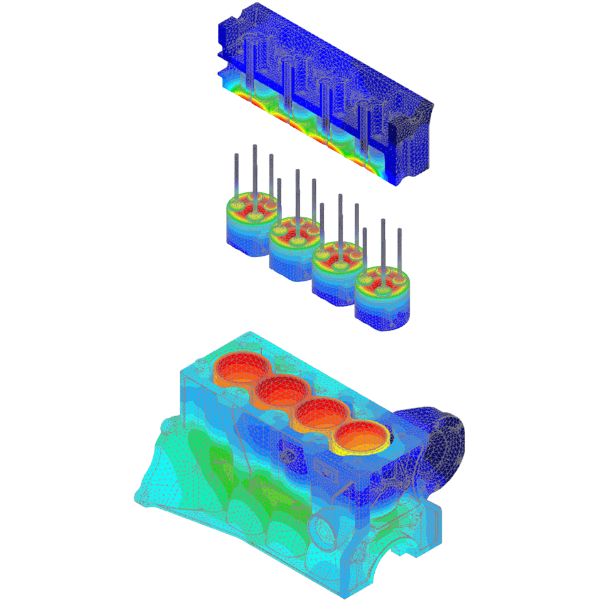
GT-SUITE powertrain cooling models can be used to predict heat rejection to coolant, oil, and ambient, before engine hardware is available for physical testing. These models utilize a built-in finite element cylinder structure for more accurate predictions of heat distribution through the engine structure. 

Powertrain cooling models integrated with other vehicle systems can also be used to analyze engine warm-up and fuel economy during transient drive cycles. Construction of GT-SUITE engine thermal models is enhanced by powerful 3D tools for converting CAD geometry into GT models. The flexible range of fidelity provides an ideal simulation environment for system design, component selection, and controls optimization.

Untitled-600-x-600-px-5

Cylinder Structure & Heat Transfer

  • Easy-to-use parametric finite element cylinder structure transfers heat from combustion gas to the coolant and oil circuits 
  • Liquid circuits and thermal masses built semi-automatically from 3D CAD data 
  • Flow solution is based on Navier-Stokes equations and is stable with zero flow to support thermostat valve modeling and advanced warm-up strategies
  • Always solves energy equation (thermo-hydraulics)
  • Heat distribution model is easy to integrate with full vehicle models for transient drive cycle analysis 
Untitled-600-x-600-px-4

Advanced Modeling Features

Group-3

Built-In FE Solver

Predicts steady-state and transient engine structure temperatures with a built-in finite element solver

Group-3

Heat Rejection Prediction

Accurately predicts heat rejection to coolant, oil, and ambient across operating conditions

Group-3

Thermal Balance Modeling

Models conduction paths between all heat sources and sinks to predict engine thermal balance

Group-3

System-Level Interaction

Captures interactions between the cooling system, thermal structure, and combustion chamber

Group-3

Warm-Up Optimization

Evaluates fuel-saving concepts for faster, more efficient warm-up of engine fluids and structure

Group-3

Zero Extra Cost

Included in every GT-SUITE license at no extra cost.

Powertrain Cooling FAQ

Answers to the most common technical questions engineers ask when evaluating GT-SUITE for powertrain cooling simulation.

What flow and thermal analysis capabilities does GT-SUITE offer?

GT-SUITE’s flow solution is built on the Navier-Stokes equations and stays stable even at zero flow, which is key for modeling thermostat valves during warm-up. The energy equation is always solved, giving engineers a full thermo-hydraulic picture of how the cooling system, structure, and combustion chamber interact.

How does GT-SUITE predict heat rejection before physical testing?

Before a single prototype exists, engineers can already see how heat moves through an engine. GT-SUITE’s built-in finite element cylinder structure models heat transfer to the coolant and oil circuits using parametric geometry, keeping setup fast even for complex designs. By modeling conduction paths between every heat source and sink, it predicts thermal balance accurately enough for system design, component selection, and controls optimization, all before physical hardware is required.

What CAD integration and model building capabilities does GT-SUITE provide?

Liquid circuits and thermal masses are constructed semi-automatically from 3D CAD data, significantly reducing manual setup time. Engineers can use a parametric finite element cylinder structure for quick iteration or a custom finite element mesh for detailed component analysis.

How does GT-SUITE analyze engine warm-up and fuel economy optimization?

Warm-up behavior has a measurable impact on fuel economy, and GT-SUITE lets engineers study it in detail before hardware is available. Connecting powertrain cooling models to full vehicle systems allows teams to simulate warm-up strategies across transient drive cycles and compare fuel savings between different approaches. Advanced thermostat valve modeling is also supported, so warm-up optimization isn’t limited to simple on/off logic.

Connect with an Expert

Ready to discuss how our 1D System Simulation services can help your project? Fill out the form below and our team will get back to you within 1 business day.

Prefer to call?

+1 (555) 123-4567 or email services@gammatech.com

By submitting this form, you agree to be contacted by GammaTech regarding our 1D System Simulation services. We respect your privacy and will not share your information with third parties. See our Privacy Policy for more details.