














Solutions

Machine Learning & Optimization Solutions

GT-SUITE includes a visual-oriented machine learning platform that enables transforming data – whether it’s generated from simulations or taken from measurements and testing – into fast-executing metamodels.

Solution Overview

Machine Learning (ML) and Optimization are transforming how engineers tackle complex challenges, driving smarter and more efficient simulation solutions. ML enhances simulation accuracy, predicts outcomes, and supports digital twins by enabling real-time data analysis and predictive insights. Optimization explores complex design spaces to find the best solutions, while balancing performance, cost, and other variables. Together, ML and Optimization in GT-SUITE empower engineers to maximize performance, improve efficiency, and innovate with precision.

Video

Application Highlights

Machine Learning and Optimization with GT-SUITE

  • Simplify Your Design

    Simplify Your Design

    One way to simplify a design of experiments or optimization study is to identify important and unimportant model input variables. Sensitivity analysis can assist engineers to determine the model inputs that are crucial for system optimization. The GT-SUITE Machine Learning Assistant provides a number of different sensitivity analysis (factor screening) methods to simplify design of experiments and optimization studies.

    Sensitivity Analysis
  • Relationship between Inputs and System Response

    Relationship between Inputs and System Response

    Real-world products and systems have inherent operation variability that can be predicted by simulation. The Monte Carlo variability analysis tool in GT-SUITE is beneficial for determining the probability density distribution of a system’s response. This information can be used to design products and systems more robustly by anticipating extreme operating conditions.

    Monte Carlo Method
  • Metamodels

    Metamodels

    Complex system-level models can be computationally expensive. The Machine Learning Assistant (MLA) in GT-SUITE aids in mitigating these challenges by converting the physical system model into a mathematical representation known as a metamodel. Metamodels provide faster simulation predictions without requiring heavy computational resources.  Both static and dynamic regression metamodels are supported in the MLA.

    Metamodeling and Optimization
  • Explore Design Trade-Offs

    Explore Design Trade-Offs

    Optimization provides a virtual test environment to evaluate multiple design concepts. Multiple optimization objectives can often compete with each other, causing trade-offs that involve sacrifices in one objective against another.  A multi-objective Pareto optimization can visualize the design trade-offs between competing objectives.

    Multi Objective Pareto Optimization
  • Model Calibration Via Optimization

    Model Calibration Via Optimization

    The GT-SUITE optimizer can support model calibration for steady state as well as transient data.  By setting the measured test data as targets, the optimizer can minimize the difference between model prediction and measurements, thereby making models more accurate.

    Weighted Sum Optimization
  • Anomaly Detection

    Anomaly Detection

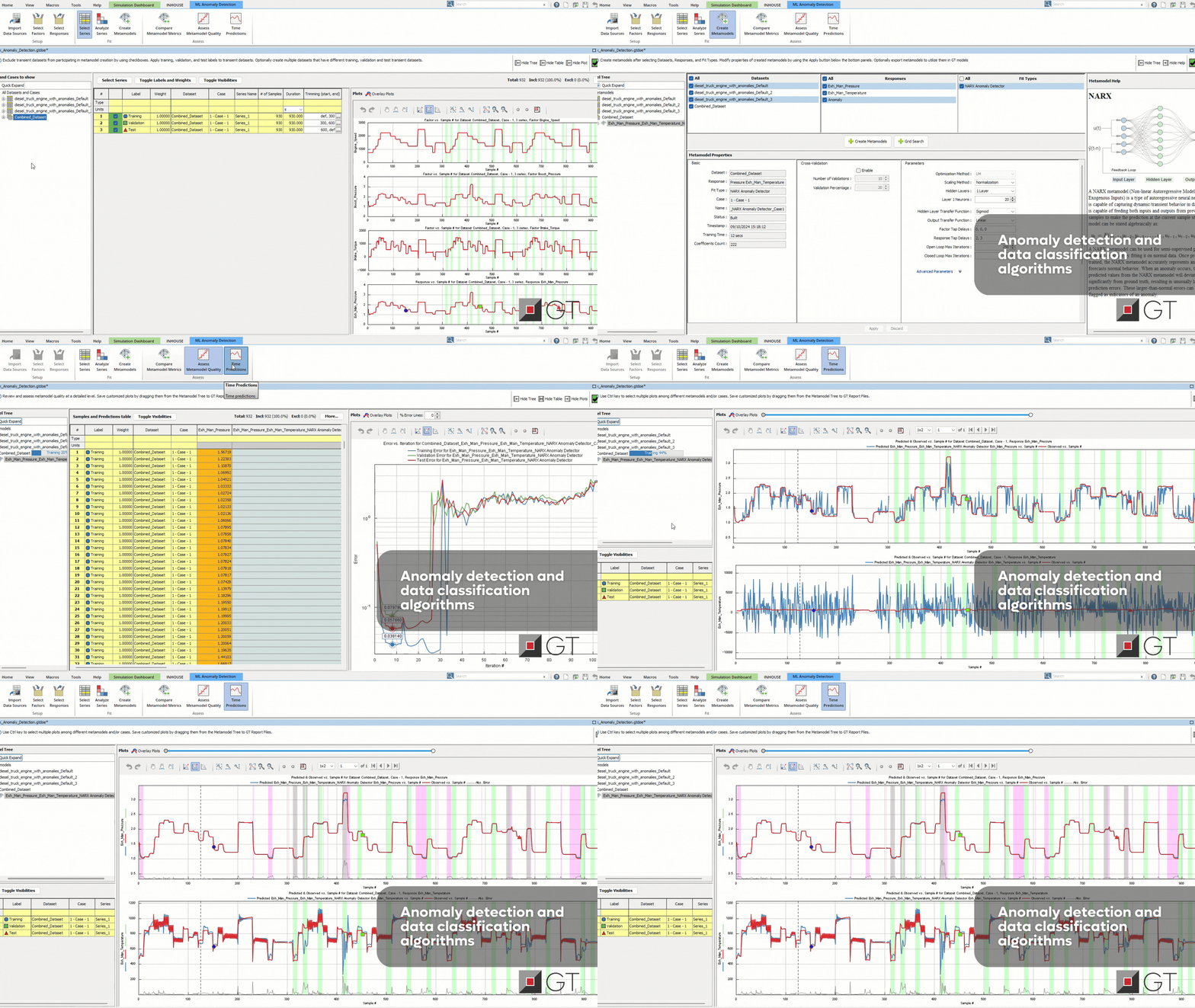
    Anomaly detection metamodels use machine learning to identify faulty or anomalous behavior based on one or many input signals and provide important functionality for digital twin frameworks where real-time monitoring of physical assets is crucial.  Time-series datasets can be imported to the Machine Learning Assistant and trained to anomaly detection metamodels.

    Anomaly-Detection-2-1

Advanced Applications

Accelerating Engineering with ML and Optimization

check mark icon

Testing and Validation

ML aids in virtual testing by predicting how designs will perform under real-world conditions using historical data, thus reducing the need for extensive physical prototypes and testing cycles. Optimization helps refine designs for improved robustness, ensuring that products perform well across various conditions, which streamlines the validation process and reduces time and costs associated with testing.


check mark icon

Regulatory Compliance and Standards

ML can help engineers predict regulatory changes and simulate compliance through data analysis, ensuring designs meet safety and legal requirements before physical testing. Optimization tools can embed these standards into the design process, automatically adjusting parameters to ensure compliance with environmental, safety, and industry-specific regulations.

check mark icon

Innovation and Technological Advancement

ML accelerates the integration of new technologies by identifying patterns and correlations in vast datasets, which helps engineers adapt faster to emerging trends. Optimization techniques enable the exploration of new design concepts by efficiently balancing multiple objectives, making it easier to innovate while maintaining performance and feasibility.