






Wear Simulation with Evolving Surface Modeling
Model progressive wear of fluid film bearings and 3D contacts under user-defined operating conditions or duty cycles.
GT-SUITE the tool of choice to design, analyze, and optimize lubrication systems and components
Solution Overview
Steady state models can be used to predict pressure, flow rate and temperature distribution throughout the oil circuit.
Transient runs can be performed to predict system priming (filling), resonance and wave dynamics in the system, energy loss in the system over a driving or duty cycle, thermal warm-up, and integration with cooling system models.
Furthermore, oil system components can be studied in detail including pumps with automated model building of vane and gerotor style pumps, bearings with both fast-running Mobility and detailed finite element options, cam phasers, and hydraulic lash adjusters.
Application Highlights
Advanced Features
Improve Reliability with Advanced Lubrication Modeling
Model progressive wear of fluid film bearings and 3D contacts under user-defined operating conditions or duty cycles.
The built-in Wear Simulation Wizard automates iterative wear progression calculations, cutting manual setup time and requiring no deep solver expertise.
Define custom finite element meshes for hydrodynamic solutions using FEMesh2D inside JournalBearingGeomFE.
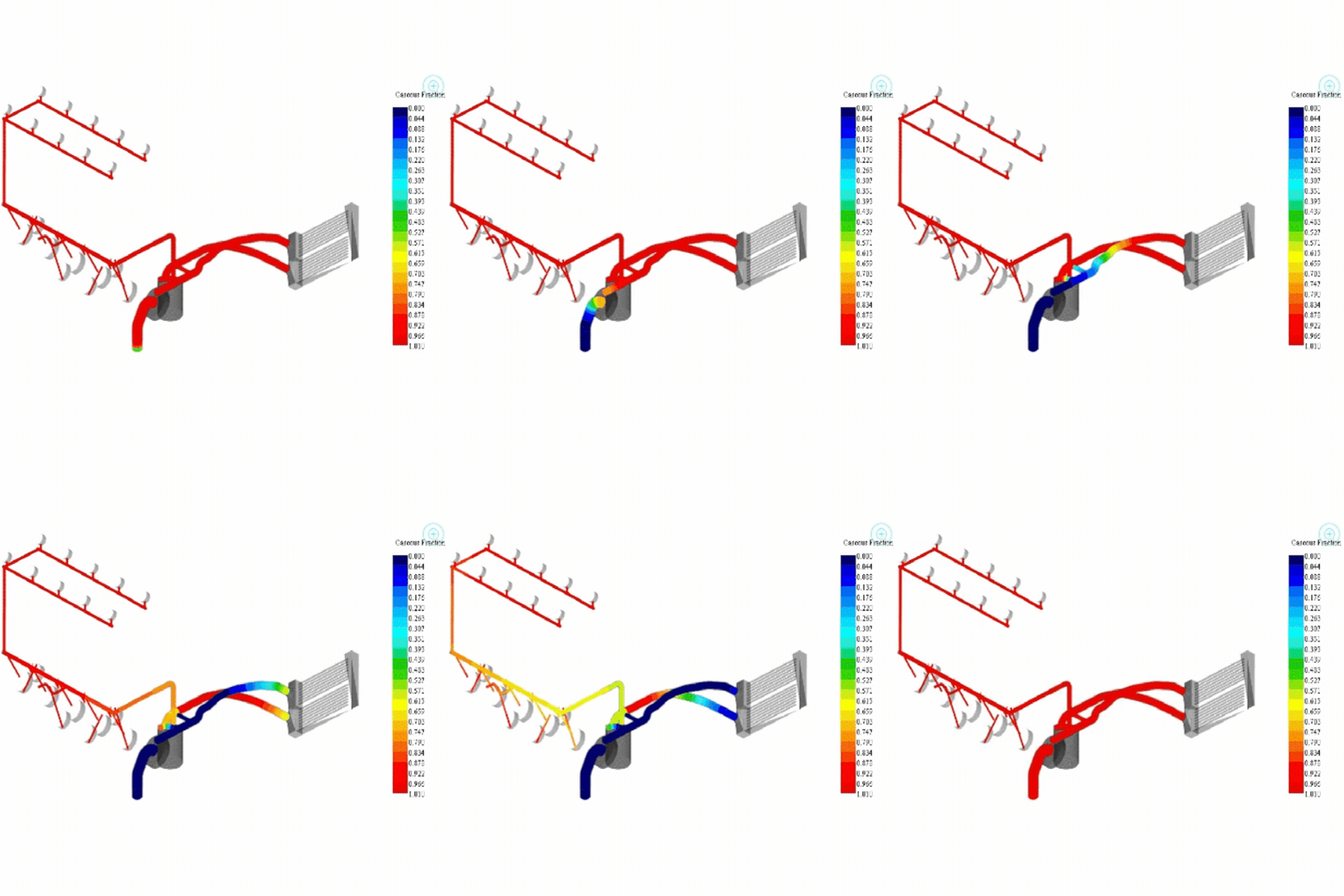
Simulate transient filling of a lubrication system from an air filled initial state, capturing oil front progression through the circuit.
Fast-running fluid property objects soften oil compressibility to increase solver time step size, cutting runtime for transient and priming studies without sacrificing design fidelity.
All oil consumers can be modeled including jets, lash adjusters, cam-phasers, turbo leakage, and others.
Find answers to common technical questions about GT-SUITE for lubrication system performance modeling.
GT-SUITE covers the full range of engine lubrication system components and scenarios. Whether you are working on a steady-state flow analysis or a complex transient simulation, the platform handles it all.
Most tools use a simplified electrical analogy to approximate oil flow. GT-SUITE solves the full Navier-Stokes equations using momentum based 1D CFD, meaning it captures real pressure wave dynamics, transient behavior, and air/vapor transport through the system. The result is more accurate predictions, especially during cold starts and under unsteady operating conditions.
GT-SUITE delivers a wide range of results, including pressure and flow rate at every point in the circuit, bearing film thickness, journal orbit, and hydrodynamic pressure, oil temperature distribution and thermal warm-up response, as well as cavitation and aeration levels throughout the system. All results are reviewed in GT-POST, where you can compare cases and plot performance across operating conditions.
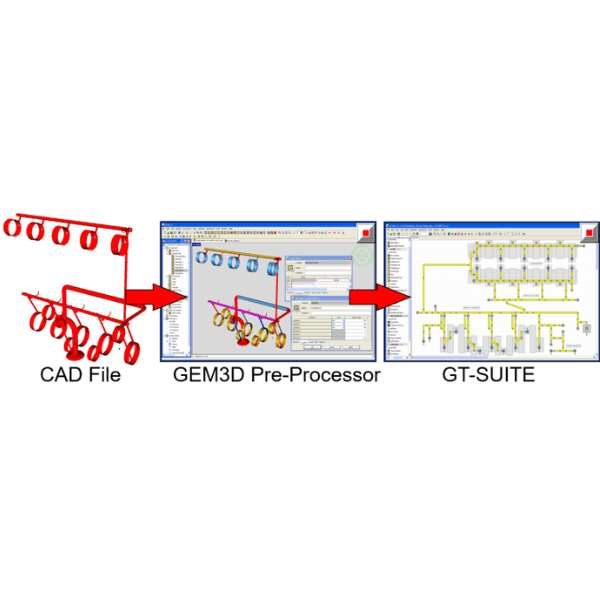
Yes. Using the GEM3D pre-processor inside GT-ISE, you can import your existing CAD geometry and convert it into a ready-to-run 1D flow network. Supported formats include ACIS (.sab), STL (.stl), and IGES (.igs). This significantly reduces model build time, especially when working from an existing engine design.