Solutions

Hybrid and Electric Vehicle

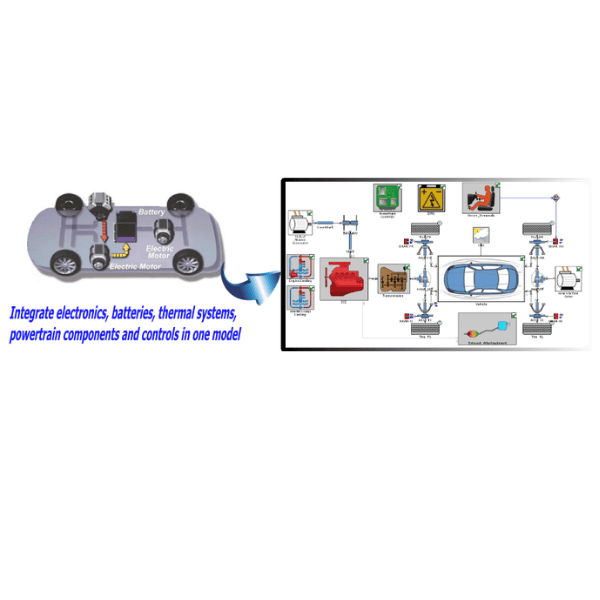
GT-SUITE unifies battery, motor, thermal management, and controls simulation in a single environment, optimizing energy management, performance, and efficiency across the full EV and HEV development cycle.

Solution Overview

From Architecture to Full-Vehicle Optimization

GT-SUITE offers advanced data and model management features, which allow you to publish libraries of components and subsystems for fast and efficient vehicle architecture studies. With GT-ISE’s object-oriented interface any electrified vehicle architecture can be built and tested for various objectives, like mileage, performance, emissions, component matching, total cost of ownership and the derivation of subsystem requirements. 

After the vehicle architecture has been determined, GT-ISE’s enables the easy integration of physical subsystems, including but not limited to thermal management and aftertreatment systems. This allows for both the integrated development of subsystems and components and the optimization of full-vehicle energy and thermal management strategies. 

As the vehicle development progresses, even more advanced analyses of electrified vehicles can be performed, including dynamic analysis of electric boosting systems with GT-POWER, NVH and drivability studies, and detailed battery, engine, and motor heat distribution.  

Untitled-600-x-600-px-600-x-600-px-600-x-600-px-1

Application Highlights

Comprehensive EV and HEV Simulation

  • Build any driveline architecture with any level of electrification, including series, parallel, series/parallel, and power-split hybrids, from micro and mild to full and plug-in hybrid designs
  • Model battery electric vehicles (BEV) with single- or multi-motor configurations
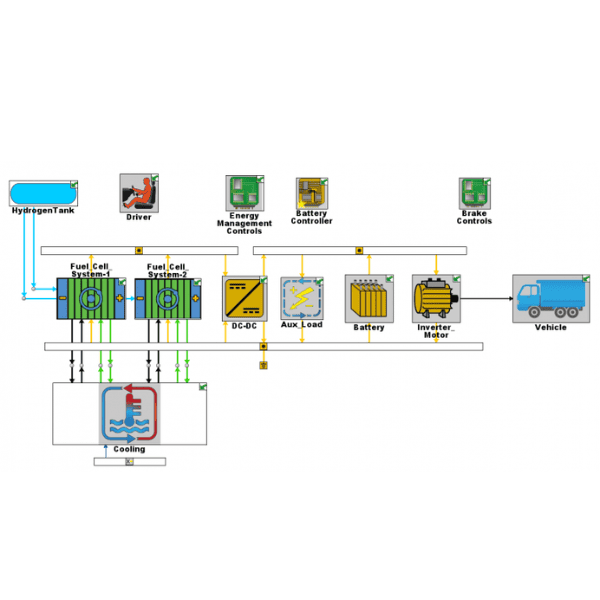
  • Model fuel cell electric vehicles (FCEV)
  • Develop controls using a comprehensive controls library, including finite state machines, or co-simulate with Simulink to design and optimize control algorithms
  • Integrate vehicle energy management with thermal management and controls optimization
  • Run standard drive cycle tests, built directly into installation
  • Test real-world driving emissions, including a random RDE cycle generator and RDE compliance checks
  • Simulate realistic driving maneuvers and driver behavior with GT-RealDrive, including vehicle-to-vehicle (V2V) interaction for driver assistance systems
Untitled-600-x-600-px-600-x-600-px-9

Advanced Simulation Capabilities

Purpose-built tools for architecture optimization, battery modeling, thermal integration, and regulatory compliance, enabling deeper insight into performance, efficiency, and drivability.

service-icon-1

Architecture and Controls Optimization

Evaluate vehicle architectures, components, and control strategies using built-in optimization and Design of Experiments (DOE) tools, without requiring external software. Accelerate design decisions and identify optimal configurations earlier in the development process.

service-icon-1

Validated Lithium-Ion Cell Library

Access a comprehensive library of Lithium-Ion cell models to accelerate battery system design and reduce reliance on physical testing. Supports accurate prediction of range, performance, and state-of-health across electrified vehicle platforms.

service-icon-1

Fuel Economy and Emissions Trade-Off Analysis

Integrate electrically heated catalysts into full-vehicle simulations to quantify the trade-off between fuel economy and emissions performance. Enables informed system-level decisions during hybrid powertrain development.

service-icon-1

Integrated Thermal and Energy Management

Couple vehicle thermal management systems with energy management strategies to ensure proper component temperature control and cabin comfort simultaneously. Enables holistic optimization across powertrain, battery, and HVAC subsystems.

service-icon-1

High-Fidelity Engine Dynamics with GT-POWER

Combine GT-POWER's 1D airflow and combustion models with electrified vehicle simulations for precise engine transient response. Refine engine controls and electric boosting strategies together in a single, unified environment.

service-icon-1

Event-Based Vehicle Testing Procedures

Configure and run event-based vehicle testing procedures aligned with regulatory standards, including EPA 5-cycle and WLTP protocols. Streamlines compliance validation and enables direct comparison of simulation results against certification requirements.

Hybrid & Electric Vehicles FAQs

Common questions about simulating hybrid and electric vehicle systems, from architecture modeling to drive cycle testing.

  • What types of hybrid and electric vehicle architectures can GT-SUITE model?

    GT-SUITE covers the full range of electrified vehicle architectures, from mild and full hybrids to plug-in hybrids, battery electric vehicles, and fuel cell electric vehicles. Whether you are working with a series, parallel, or power-split topology, the platform gives you the flexibility to build and test virtually any driveline configuration without being locked into predefined templates.

  • Can GT-SUITE be used for EV range prediction and regulatory certification?

    Yes. GT-SUITE automates the EPA 5-cycle test procedure in line with SAE J1634, covering the Multi-Cycle Test, Short Multi-Cycle Test, and standalone 5-cycle test. Rather than running manual, iterative calculations, engineers get a streamlined, repeatable process that takes them from simulation directly to label range prediction, which matters a great deal when certification timelines are tight.

  • How does GT-SUITE help engineers size and optimize hybrid electric components early in development?

    GT-DRIVE+ lets engineers rapidly evaluate motor configurations, size batteries and motors, and generate efficiency maps, all within one environment. The built-in optimizer can sweep through hundreds of design combinations automatically, helping teams hit performance targets like acceleration and fuel economy well before any hardware is built.

  • Can GT-SUITE simulate real-world driving scenarios, including traffic, for electrified vehicles?

    It can. GT-SUITE connects with traffic simulation tools such as SUMO through a Simulink co-simulation interface, allowing engineers to study powertrain behavior in realistic, unpredictable traffic conditions. This means you can account for variable driver behavior, vehicle interactions, and physical constraints like battery limits and motor torque, all in a single, integrated simulation.

Connect with an Expert

Ready to discuss how our 1D System Simulation services can help your project? Fill out the form below and our team will get back to you within 1 business day.

Prefer to call?

+1 (555) 123-4567 or email services@gammatech.com

By submitting this form, you agree to be contacted by GammaTech regarding our 1D System Simulation services. We respect your privacy and will not share your information with third parties. See our Privacy Policy for more details.