





Solutions

Exhaust Aftertreatment Modeling

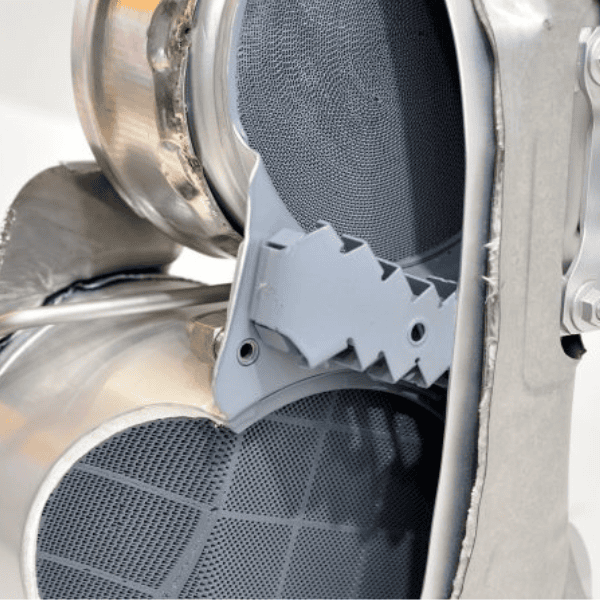
GT-SUITE exhaust aftertreatment modeling simulates catalyst and filter performance to reduce NOx, CO, HC, and PM emissions across all drive cycles.

Solution Overview

One Tool, Every Aftertreatment System

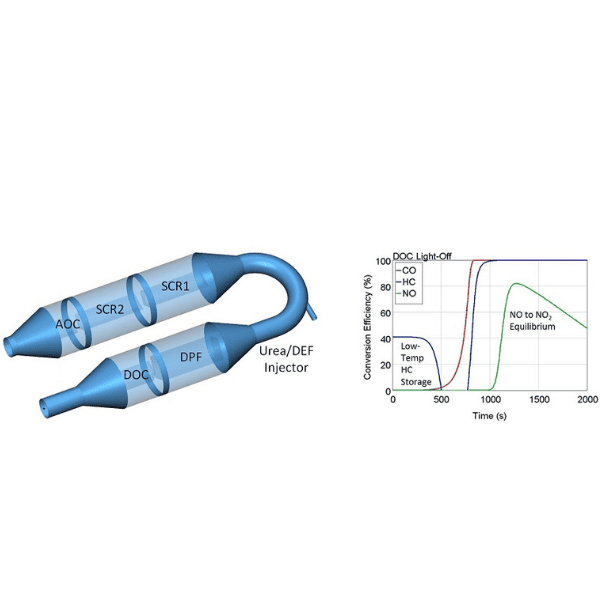
GT-xCHEM enables the user to model any AT device in isolation or within an integrated system, while providing the user the complete flexibility to modify and impose the participating kinetic reaction mechanisms.

The design of this library is consistent with our goal to provide a single tool for simulation of all aspects of engine and vehicle systems. This library allows modeling the exhaust aftertreatment system together with vehicle, engine, thermal management, and control systems, making this tool uniquely suitable for collaborative development.

Untitled-600-x-600-px-76

Application Highlights

Flexible Aftertreatment System Modeling

  • Built-in two-way coupling with 3D CFD (CONVERGE™) for high-fidelity flow and mixture distribution accuracy
  • Quasi-2D/3D modeling of filters and catalysts for spatial accuracy without full CFD cost
  • Highly flexible interface for entering and modifying any reaction mechanism
  • Advanced Adaptive chemistry solver for fast, accurate solutions to stiff, non-linear systems
  • Fast Quasi-Steady (QS) solver compatible with Real-Time (RT) execution for HIL testing
  • Built-in direct and DOE optimizers for kinetic parameter calibration, including genetic algorithm (GA)
  • Electrically Heated Catalyst (EHC) modeling for cold-start and light-off optimization
  • 1D droplet tracking for urea injection and reagent dosing simulation
  • Structured mesh with symmetry reduction for faster 2D/3D catalyst simulations
  • Native lambda and NOx sensor models for closed-loop control development
Untitled-600-x-600-px-75

Advanced Aftertreatment Integration

GT-xCHEM supports every aftertreatment architecture with real-time, ECU-compatible integration for vehicle and control system development.

icon-analysis 1

Full System Integration

Model any aftertreatment component in isolation or as part of a fully integrated system encompassing engine, vehicle, driveline, and controls. This unified approach eliminates the need for separate tools and enables comprehensive system-level trade-off analysis.

icon-analysis 1

Real-Time Virtual Coupling

Achieve real-time simulation performance through virtual coupling with engine, vehicle, and control sub-systems, without compromising physical accuracy. This capability is essential for hardware-in-the-loop (HIL) testing and ECU-compatible plant model development.

icon-analysis 1

Electrically Heated Catalyst (EHC) Modeling

Simulate electrically heated catalyst systems with electrode-level detail to optimize cold-start thermal management and catalyst light-off strategies. This capability directly supports compliance with increasingly stringent low-temperature emissions regulations.

icon-analysis 1

Reagent Dosing and Regeneration Control

Develop and validate control strategies for urea injection, ammonia dosing, and fuel-based DPF regeneration within a single simulation environment. Tight integration with control sub-systems enables rapid calibration and optimization of dosing logic.

icon-analysis 1

Drive Cycle and Real Driving Emissions (RDE) Simulation

Evaluate aftertreatment system performance across standardized drive cycles and real-world route-based scenarios, including RDE compliance assessments. The fast quasi-steady solver enables efficient transient simulations at scale.

icon-analysis 1

Advanced Catalyst and Filter Coverage

Support the full spectrum of modern aftertreatment architectures, including SCR-DPF, EHC, TWC, DOC, LNT, GPF, and Methane Oxidation Catalysts, within a single, consistent modeling framework. This breadth ensures the tool remains applicable as powertrain technologies evolve toward zero-carbon and low-carbon fuels.

Exhaust Aftertreatment Modeling FAQs

Answers to common questions about exhaust aftertreatment modeling with GT-xCHEM.

Connect with an Expert

Ready to discuss how our 1D System Simulation services can help your project? Fill out the form below and our team will get back to you within 1 business day.

Prefer to call?

+1 (555) 123-4567 or email services@gammatech.com

By submitting this form, you agree to be contacted by GammaTech regarding our 1D System Simulation services. We respect your privacy and will not share your information with third parties. See our Privacy Policy for more details.