







Detailed Fuel Tank Modeling
Detailed fuel tank model including fuel evaporation.
Solutions
GT-SUITE simulates the full EVAP system, canister, purge valve, and fuel tank, to optimize hydrocarbon capture and meet emissions compliance.
Solution Overview
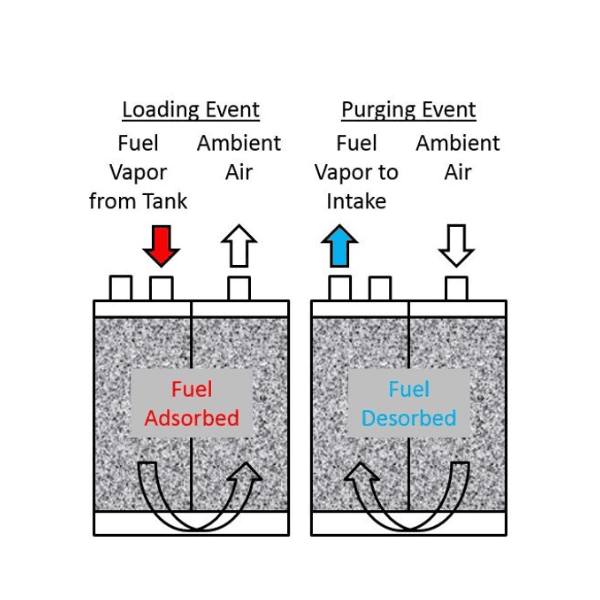
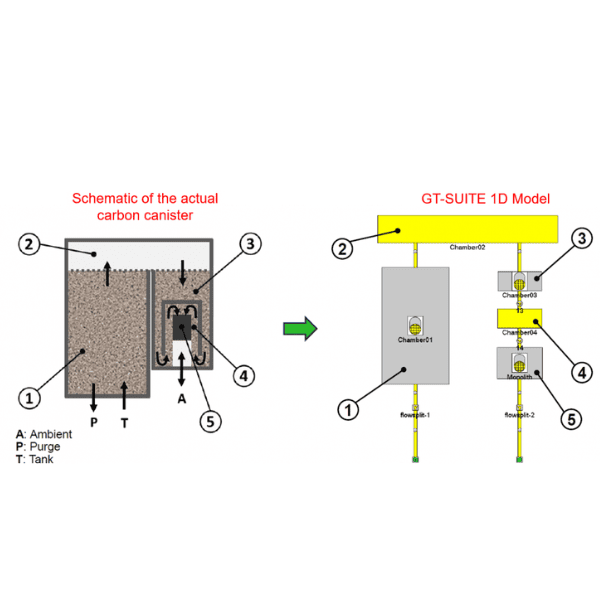
GT-SUITE simulation software includes advanced solvers and components for modeling the entire Evaporative Emission Control System (EVAP), including the flow network, carbon canister, and canister purge valve (CPV). An activated carbon canister is used to capture hydrocarbon vapor emissions from the fuel tank as part of an EVAP system. The user has full control over defining the heterogeneous reaction mechanism for modeling the hydrocarbon adsorption and desorption in the carbon canister. There is increasing interest in optimizing the carbon canister size for hydrocarbon storage, and optimizing the CPV control strategy, especially for turbocharged gasoline direct injection (GDI) engines and hybrid electric vehicles (HEV/PHEV).
GT-SUITE allows you to evaluate how a purge event affects engine performance and emissions. You can also choose when and where to purge during a drive cycle, for example, in an intake manifold under vacuum conditions or upstream of the compressor during boosted conditions. EVAP system components can be modeled in isolation or together with vehicle, engine, thermal management, and control systems, making this tool uniquely suitable for system level optimization and collaborative engineering.

Application Highlights
Advanced Features
From fuel tank vapor generation to canister purging and CPV control, explore how GT-SUITE’s EVAP carbon canister simulation models every stage of the system, in isolation or fully integrated.
Detailed fuel tank model including fuel evaporation.
Diurnal test cycle, modeling the flow and diffusion of fuel vapor from the fuel tank to the carbon canister during low/zero flow conditions.
Simulate the full adsorption and desorption cycle of hydrocarbon vapor within the activated carbon canister. Optimize canister sizing and working capacity to meet emissions targets.
Evaluate CPV design variants and duty cycle strategies across the full range of engine operating conditions, including turbocharged and hybrid powertrains.
Accurately represent canister vent and check valve behavior within the EVAP flow network to capture pressure dynamics and vapor containment performance.
Air Induction System Hydrocarbon Trap (AIS HC Trap) modeling.
Common questions about modeling carbon canisters, purge strategy, and full EVAP system integration in GT-SUITE.
GT-SUITE covers the full EVAP system, the flow network, activated carbon canister, canister purge valve, canister vent valve, and even the AIS hydrocarbon trap. You can model each component on its own or connect them with your engine, vehicle, thermal, and control models for a complete system view. That flexibility is what makes it useful whether you’re validating a single component or optimizing the whole architecture.
You define the reaction mechanism yourself, there’s no black-box chemistry baked into the tool. GT-SUITE also accounts for the thermal mass of the hydrocarbons stored in the canister, which matters more than people expect since the carbon can hold a substantial amount of fuel vapor. That level of control lets you calibrate loading and purging behavior against your own test data.
Yes, this is actually one of the more common use cases we see. You can test purge timing and location, intake manifold under vacuum or upstream of the compressor during boost, and see exactly how it trades off against engine performance and emissions. For HEV/PHEV applications where the engine’s off more often, this kind of duty cycle analysis is especially useful for finding a workable purge window.
EVAP models built in GT-SUITE plug directly into your engine, vehicle dynamics, thermal management, and control system models. That means you can see how canister purging actually affects fuel economy, drivability, and emissions compliance, not just in isolation, but across real drive cycles. It’s built for exactly this kind of cross-team, system-level work.