




Wear and Seizure Root Cause Analysis
Root cause investigation of wear and seizure issues.
GT-SUITE assesses the impact of operating conditions and design parameters on friction and seeks low friction designs
Solution Overview
This functionality uses the validated fundamental tribological elements of GT-SUITE, including oil film hydrodynamics and EHD contact models, a statistical asperity contact model, and also on the ability to take temperature, pressure and shear rate dependence of lubricant viscosity, as well as geometrical details, into account.
Application of these elements enable GT-SUITE to model, at each friction interface, the share of load carried hydrodynamically vs. by contact, which is essential to accurate prediction of friction.
In addition to friction, models predict secondary motions (orbits, film thicknesses), oil flow, wear load, contact deformations, Hertz stress and temperature rise. Tribological elements are used directly, inside GT-SUITE MBD models of moving parts of engines, pumps etc. which provide the speeds and load at friction interfaces.
Application Highlights
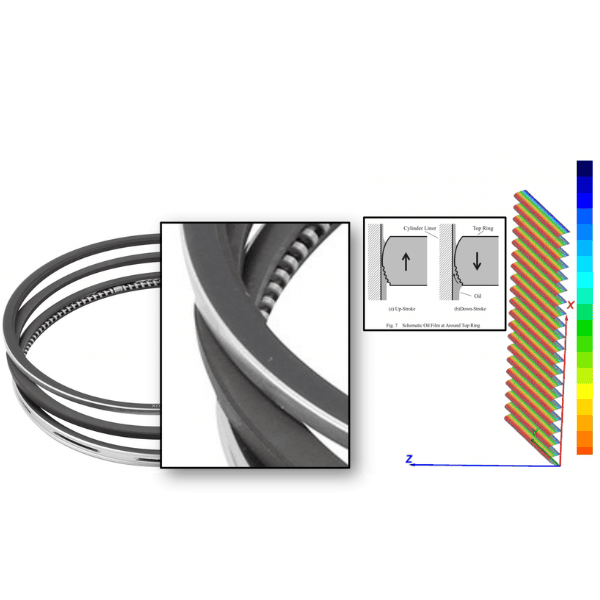
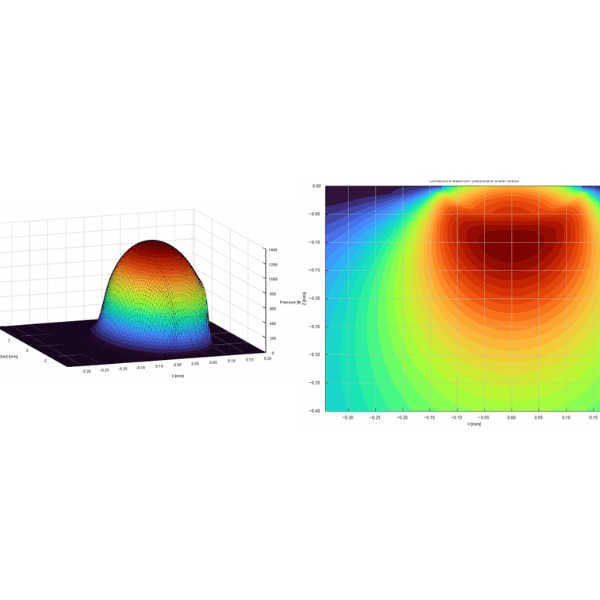
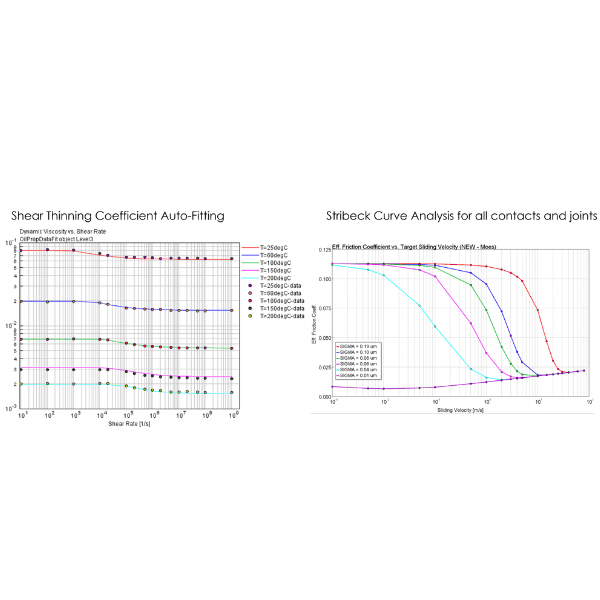
Advanced Features
GT-SUITE supports advanced wear analysis, root cause diagnostics, surface texturing, and fully integrated MBD and lubrication modeling.
Root cause investigation of wear and seizure issues.
Fully integrated with lubrication system models.
Fully integrated with MBD models of cranktrains, valvetrains, others.
Fast simulation times suitable for multi-variable DoEs.
Evaluate 1D and 2D surface micro-texturing effects on friction and film thickness.
New in v2026, model the progression of wear over defined duty cycles, with evolving surface roughness captured iteratively.
Answers to common questions about friction and tribology modeling with GT-SUITE.
GT-SUITE models each friction interface individually using validated tribological elements that capture the balance between hydrodynamic load carrying and asperity contact. Journal bearings, piston rings, piston skirts, valvetrain contacts, and turbocharger bearings are all handled within a single simulation environment, with no simplified global friction maps required.
At each interface, GT-SUITE reports minimum oil film thickness, orbit predictions, wear load, oil temperature rise, contact deformations, Hertz stress, and secondary motions. At the engine level, full component-by-component friction reporting makes it straightforward to identify where losses are concentrated and prioritize design changes.
Yes. Tribological models run directly inside GT-SUITE’s MBD models of cranktrains, valvetrains, and timing drives, and are fully coupled with lubrication system models. Oil supply pressure, temperature, and flow conditions feed directly into friction calculations, giving you a physically consistent system rather than isolated component results.
Simulation times are optimized for multi-variable design of experiments. Engineers routinely sweep bearing geometries, surface finishes, oil grades, and operating conditions across large parametric studies. The 2026 release also introduced a dedicated Wear Simulation wizard that automates wear progression analysis over duty cycles, reducing manual effort in iterative studies considerably.