





Any Fuel, Any Combustion Mode
Analyze SI, diesel, dual-fuel, HCCI, and more — all from a single platform. Simplifies your workflow across the entire engine program instead of juggling mode-specific tools.
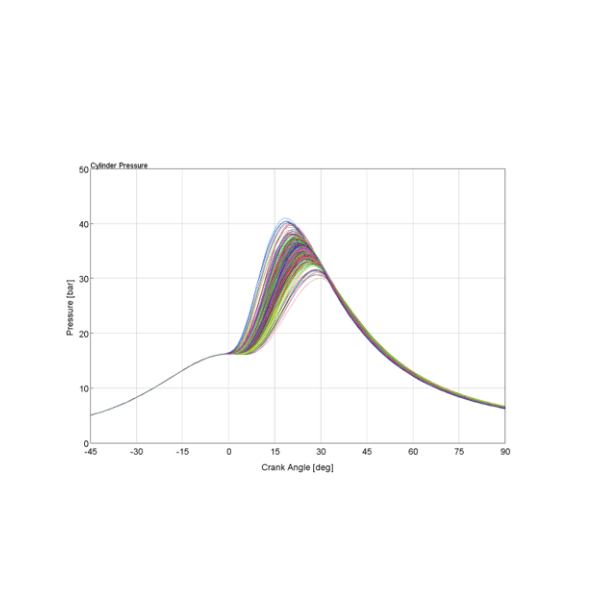
Analyze measured cylinder pressure directly in GT-POWER to calculate burn rates, validate test data, and calibrate predictive combustion models.
Solution Overview
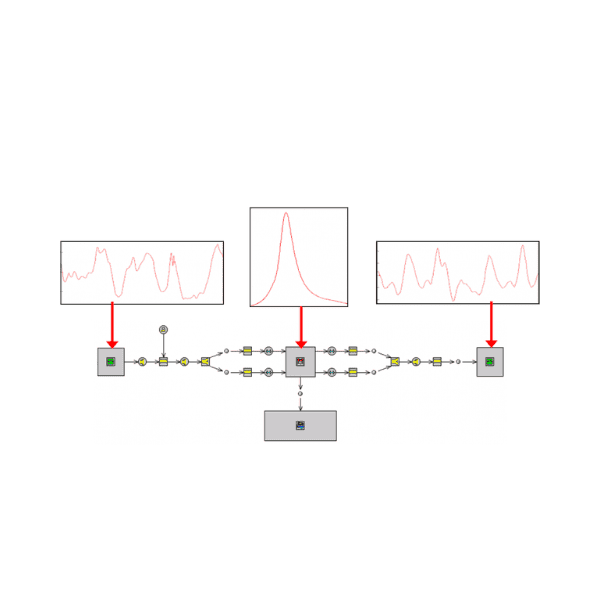
These capabilities bridge the gap between engine testing and simulation to provide detailed combustion analysis, as well as gas exchange analysis and measured data validation.
Measured cylinder pressure is directly analyzed in GT-POWER and the resulting burn rates are calculated and output using the same solution methodology as the engine model, ensuring perfect consistency between measurement analysis and simulation.
Models can be easily setup to reference large amounts of measurement data, making quick but insightful analysis leading to burn rate profiles, cylinder trapped conditions and even calibration of predictive combustion models. These capabilities form the foundation for defining combustion in today’s modern engine simulation.
APPLICATION HIGHTLIGHTS
ADVANCED FEATURES
Go beyond standard pressure analysis with tools built for precision calibration, cycle-level diagnostics, and faster combustion modeling.
Analyze SI, diesel, dual-fuel, HCCI, and more — all from a single platform. Simplifies your workflow across the entire engine program instead of juggling mode-specific tools.
Accurately quantify residual gas fraction, scavenging, and fuel short-circuiting, then fine-tune port flow, valve events, and thermal effects in the same step. One integrated workflow gets your model calibration-ready faster.
Go beyond ensemble averages and analyze individual combustion cycles to capture true cycle-to-cycle variation. Essential for diagnosing instability in modern lean-burn and boosted engine designs.
Instantly flag and correct pressure pegging, phasing errors, and signal-to-noise issues before they skew your results. Every analysis runs on verified, trustworthy measurement data.
Automatically generate burn rate profiles and Wiebe fits ready to drop into your engine model. Cuts manual curve-fitting time and accelerates calibration.
Pinpoint knock onset angle and intensity, cycle by cycle, to support combustion system design and calibration decisions. Gives engineers the diagnostic precision to push performance limits safely.
Common questions about Cylinder Pressure Analysis in GT-SUITE — from TPA and CPOA to burn rate calculation and combustion calibration.
The three most impactful error sources are incorrect pressure phasing, incorrect gauge pressure, and an inaccurate compression ratio. Pressure phasing errors are best identified by examining motored pressure data, where peak pressure should occur approximately 0.5 to 1 degree before TDC. Gauge pressure errors produce visible curvature on a LogP-LogV plot during the pumping loop, while compression ratio errors manifest as curvature near the end of the compression stroke. Addressing these in order of significance will have the greatest effect on the accuracy of the resulting burn rate.
M+P mode runs both a burn rate calculation from measured cylinder pressure and a forward simulation of the predictive combustion model simultaneously, using identical initial conditions. This direct side-by-side comparison makes it straightforward to identify and close the gap between measured and predicted combustion behavior. GT-ISE includes an automated converter tool that can generate an M+P model directly from an existing TPA model, significantly reducing setup time.