Solutions

Bearings, EHD

Bearing simulation integrated with cranktrain, lubrication, and thermal models — evaluated under real operating conditions.

Solution Overview

Advanced Bearings & EHD Modeling

Bearing performance has a direct impact on engine durability, friction losses, and system reliability. Engineers need simulation tools that reflect the physical complexity of hydrodynamic and elasto-hydrodynamic lubrication, not simplified models that miss critical load cases. GT-SUITE’s bearing simulation solution solves the full Reynolds equation to predict oil film pressure, minimum film thickness, journal orbit, and metal-to-metal contact across the complete operating cycle. When elastic deformation of the bearing shell or journal is significant, the EHD solver accounts for structural compliance, giving engineers accurate film thickness predictions under high-load conditions where rigid-body assumptions break down.

Bearing models run natively within the GT-SUITE environment, they receive realistic boundary conditions from connected crankshaft, lubrication, and thermal models. This integration eliminates the need to manually transfer loads between tools and ensures that bearing assessments reflect true system behavior. The result is faster design iteration, reduced physical testing, and greater confidence in bearing survival predictions before hardware is built.
Finite Element Analysis (FEA)

Application Highlights

Simulation Capabilities

  • Rigid or flexible (EHD) joint options supporting both dynamic and quasi-steady load analysis across journal and thrust bearing types (Both models)
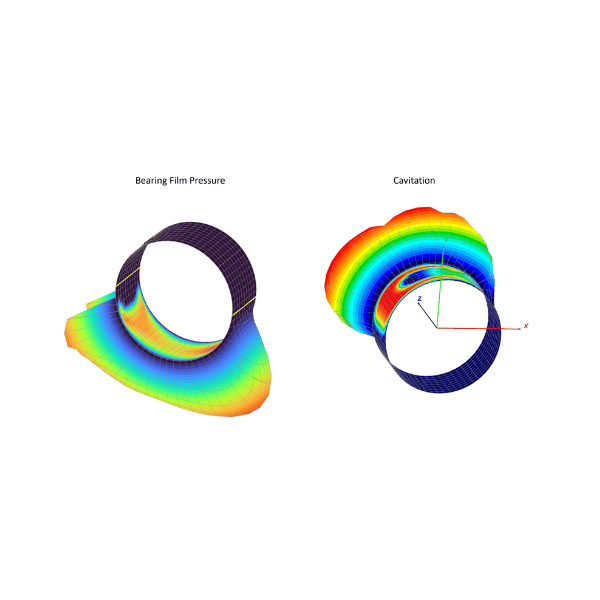
  • Mass-conserving cavitation algorithm ensuring physically accurate film pressure solutions (FE-HD model)
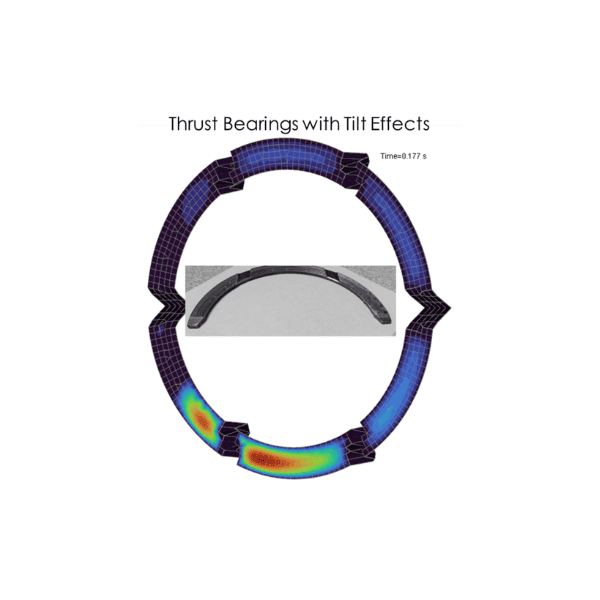
  • 2D and 3D planar analysis with tilt capability for comprehensive bearing load assessment (FE-HD model)
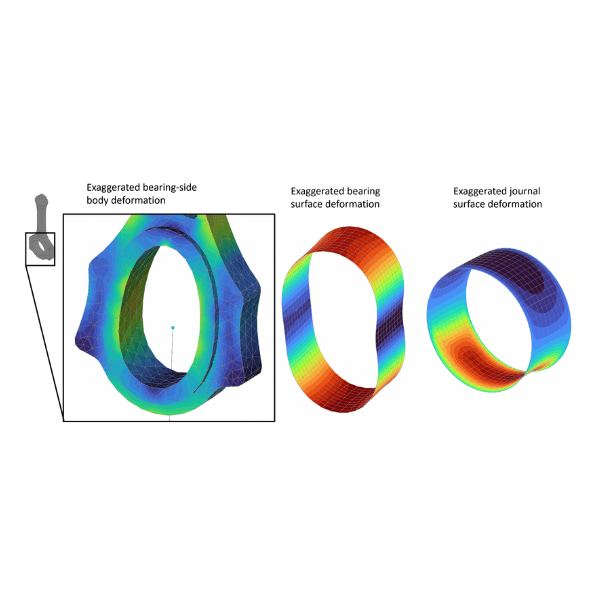
  • Dynamic elasticity modeling with deformable bodies, including journal-side flexibility via Double-EHD (FE-HD model)
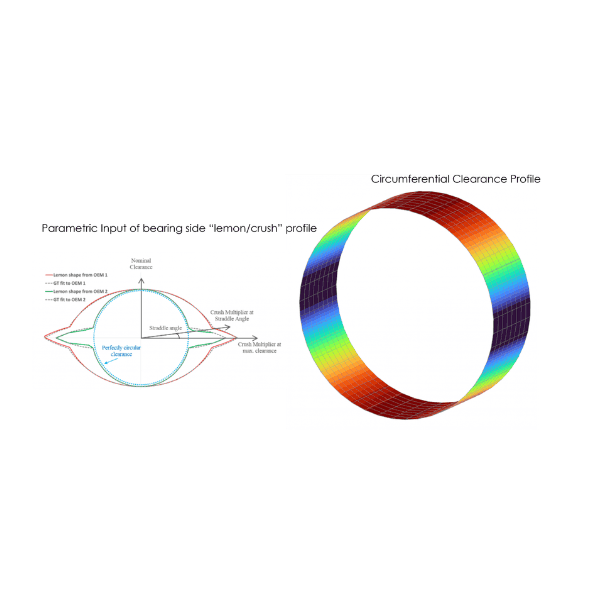
  • Distorted clearance shape input to account for real-world manufacturing and assembly deformation (Both models)
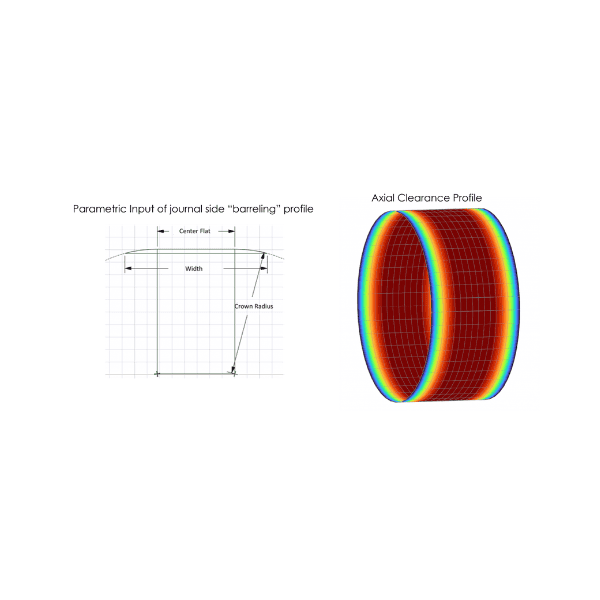
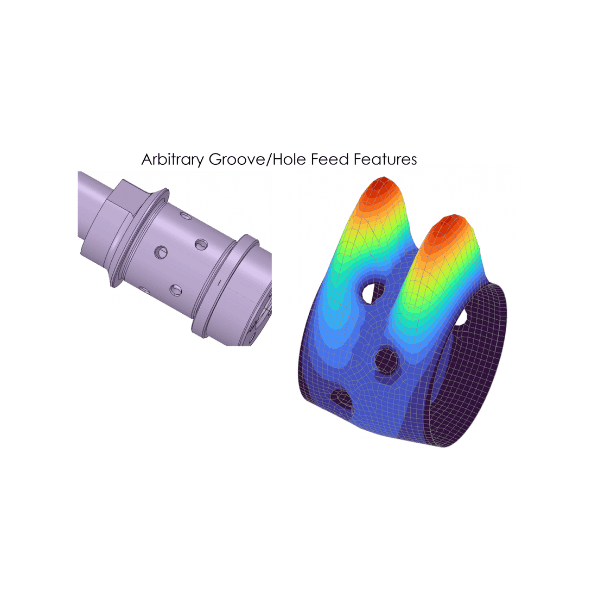
  • Arbitrary feed and drain feature definitions with parametric axial and circumferential profile input methods (FE-HD model)
  • Thrust bearing support with user-defined wedge profiles, pad groove consideration, and completely arbitrary shaped mesh domains
  • Roller bearing modeling (ball and needle styles) with load distribution and friction torque based on ISO standards
  • Direct integration with flow networks and system-level cranktrain, valvetrain, and lubrication models for full system simulation
Untitled (600 x 600 px) (83)
Untitled (600 x 600 px) (600 x 600 px) (600 x 600 px) (5)
Bearings, EHD Simulation
Untitled (600 x 600 px) (600 x 600 px) (17)
Untitled (600 x 600 px) (600 x 600 px) (600 x 600 px) (600 x 600 px)

High-Fidelity Bearing Modeling

Analyze bearing performance using advanced EHD, deformation, and load distribution methodologies.

service-icon-1

Peak Oil Film Pressure Prediction

Accurately resolve maximum hydrodynamic pressure across the bearing surface to identify overloading conditions before they occur. This output directly supports bearing geometry optimization and material selection decisions.

service-icon-1

Full Pressure Field Visualization

Capture the complete 2D or 3D oil film pressure distribution throughout the bearing cycle, providing engineers with spatial insight into load-carrying behavior and pressure gradients that point-based metrics cannot reveal.

service-icon-1

Mass-Conserving Cavitation Analysis

GT-SUITE applies a mass-conserving cavitation algorithm to accurately predict film rupture and reformation zones within HD bearings. This prevents over-prediction of load capacity and ensures reliable performance assessment under real operating conditions.

service-icon-1

Minimum Film Thickness and Metal-to-Metal Contact

Simultaneously track minimum oil film thickness and the onset of asperity contact to assess bearing survival margins under high-load or transient conditions. This merged capability gives engineers a direct indicator of wear risk and seizure potential.

service-icon-1

Dynamic Journal Orbit Tracking

Simulate the full trajectory of the journal within the bearing clearance across the operating cycle, enabling engineers to assess dynamic stability, eccentricity behavior, and proximity to bearing boundaries under realistic load conditions.

service-icon-1

Integrated Thermal Balance Modeling

Predict temperature rise within the oil film using a thermal balance model that accounts for viscous dissipation and heat transfer, ensuring lubricant performance and bearing integrity are maintained across the full operating range.

Bearings and EHD FAQs

Find answers to common questions about bearings and Elastohydrodynamic Lubrication (EHD)

  • Can GT-SUITE's bearing models be used within full system-level simulations, or do they run in isolation?

    GT-SUITE bearing models are designed for direct integration into system-level models, including cranktrains, valvetrains, and oil circuits, without any co-simulation overhead. This means bearing performance is evaluated under realistic, coupled loading conditions rather than simplified bench assumptions, giving engineers results they can trust for production-level decisions.

  • How does GT-SUITE handle cavitation in hydrodynamic bearings?

    GT-SUITE applies a mass-conserving cavitation algorithm that accurately captures both film rupture and reformation throughout the bearing cycle . This prevents the over-prediction of load capacity that simpler models produce, ensuring that flow rate calculations and pressure distributions reflect real operating behavior.

  • What is EHD, and when does a bearing simulation require it?

    Elasto-Hydrodynamic (EHD) analysis accounts for the elastic deformation of the bearing shell and journal under hydrodynamic pressure — effects that become significant in high-load or precision applications where surface deflection influences film thickness . GT-SUITE supports both single-sided and Flex-Flex EHD configurations, allowing engineers to apply the appropriate level of fidelity based on the structural flexibility of the components involved.

  • What outputs does GT-SUITE provide to assess bearing survival and wear risk?

    GT-SUITE reports minimum oil film thickness, peak oil film pressure, metal-to-metal contact, and journal orbit throughout the operating cycle . Together, these outputs give engineers a direct, quantitative basis for evaluating wear risk, seizure potential, and whether a bearing design meets its durability targets under transient and steady-state conditions.

Connect with an Expert

Ready to discuss how our Systems Simulation services can help your project? Fill out the form below and our team will get back to you within 1 business day.

Questions before you submit?

Email us at services@gammatech.com

By submitting this form, you agree to be contacted by Gamma Technologies regarding our services. We respect your privacy and will not share your information with third parties. See our Privacy Policy for more details.