









Physics-Based Compressor Modeling
Accurately simulate compressor behavior under real operating conditions using first-principles physics. Enables precise performance prediction and supports both design optimization and controls development.
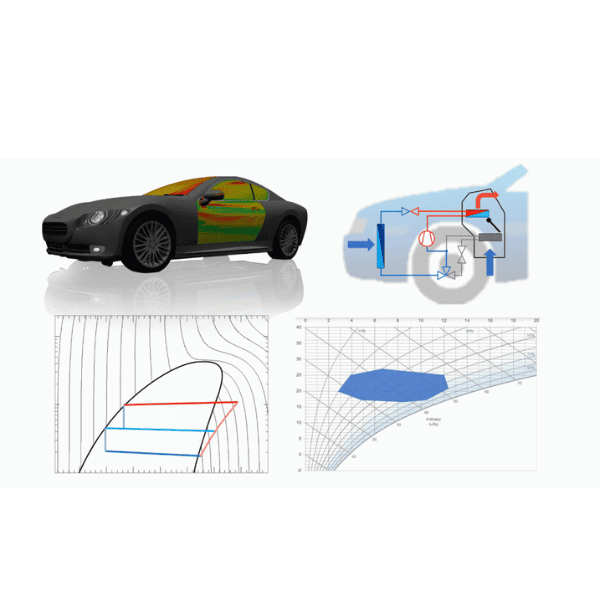
GT-SUITE simulates complete HVAC systems—from refrigerant cycles to cabin comfort—predicting performance and efficiency before physical testing.
Solution Overview
Refrigerant systems play an increasingly important role in modern thermal management systems. GT-SUITE’s highly-developed solver is robust and stable for two-phase circuits in transient conditions, even with zero flow. A vast library of refrigerant properties are included with the built-in property calculations from NIST REFPROP.
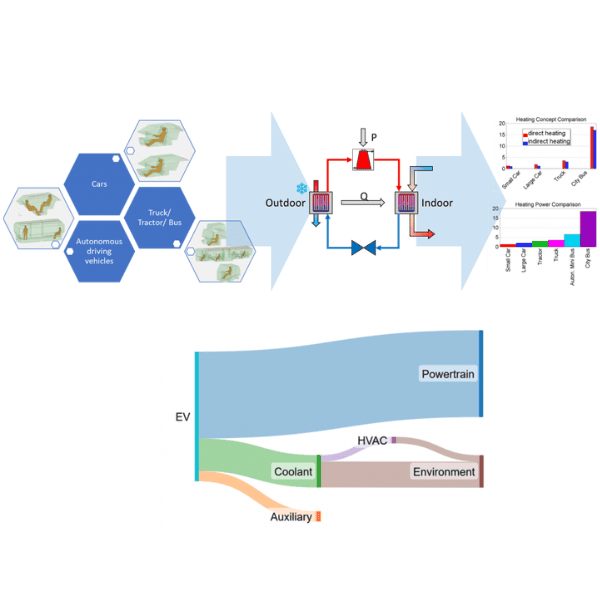
GT-SUITE can model traditional A/C systems as well as heat pumps, supercritical CO2 systems, multiple branch systems and more. Refrigerant circuits can be easily integrated with coolant circuits, cabins, and vehicle and powertrain models for complete system thermal and energy management.
Application Highlights
Advanced Features
Model complex refrigerant circuits, heat pumps, and CO₂ systems with high-fidelity simulation for accurate performance prediction and complete thermal management analysis.
Accurately simulate compressor behavior under real operating conditions using first-principles physics. Enables precise performance prediction and supports both design optimization and controls development.
Estimate heat exchanger performance directly from geometry using predictive correlations, or auto-calibrate to measured data. Reduces test burden and accelerates component integration into system-level models.
Determine the optimal refrigerant charge quantity for any system configuration, including ICE and EV platforms. Shortens development cycles and reduces costly physical testing.
Simulate complete operating cycles from steady-state conditions through demanding transient events such as pull-down and heat-up. Captures real-world system behavior across the full operating envelope.
Model two-phase refrigerant loops for battery thermal management in electric vehicles, fully integrated with powertrain and HVAC systems. Supports the design of efficient, safe thermal architectures for EV platforms.
Couple refrigerant and HVAC circuit models with GT-TAITherm's high-fidelity cabin environment simulation to evaluate occupant thermal comfort. Enables comfort-driven system design without requiring physical prototypes.
Find answers to common questions about GT-SUITE’s air conditioning and heating simulation capabilities, modeling approaches, and supported applications.
Yes — the platform covers the full operating range, from steady-state performance analysis to demanding transient events like cabin pull-down and heat-up cycles. That means you can evaluate system behavior under real-world driving conditions instead of being locked into a single operating point.
Engineers can predict heat exchanger performance directly from geometry using built-in correlations, or auto-calibrate component models against whatever measured data is available. Either way, it cuts down on physical prototypes and speeds up how quickly a component gets integrated into the full system model.
Absolutely. It’s well suited to EV thermal system development, including two-phase refrigerant loops used for battery thermal management. The refrigerant circuit can also be fully integrated with powertrain and energy management models, giving a complete picture of thermal behavior across real drive cycles.
Two-phase refrigerant flow is handled through void fraction modeling, which is critical for accurate charge prediction and system performance analysis. You can choose from established correlations or implement custom ones, depending on how much control you need over phase distribution across components.