








Blog
Simulating Lithium–Sulfur Batteries for UAV Missions with GT-AutoLionSulfur
Overview
As industries push for lighter and more energy-efficient solutions, lithium–sulfur (Li–S) batteries are gaining increasing attention. Their appeal is clear: they offer the potential for much higher energy per weight than conventional lithium-ion batteries while using sulfur, an abundant and low-cost material.
But while the promise is real, so are the challenges. Unlike lithium-ion batteries, which are now well understood and widely deployed, Li-S technology is still evolving. One of the main reasons is that Li–S batteries behave in ways that are far more complex and less predictable. To unlock their potential, engineers first need a better way to understand how they actually work.
The Challenge with Li-S Battery Modeling
At a high level, all batteries store and release energy through chemical reactions. However, Li-S batteries do not follow the relatively straightforward reaction pathways seen in lithium-ion systems. Instead of a single, straightforward reaction, Li–S batteries operate through multiple electrochemical steps, where sulfur transforms into a series of intermediate compounds (called polysulfides) during charge and discharge. These processes introduce several unique behaviors:
- Multi-step reactions: Sulfur does not convert directly, but through a chain of intermediate species, each affecting voltage and performance.
- Polysulfide shuttle: Dissolved polyulfide species can migrate between electrode, causing side reaction that leads to loss of active materials and capacity.
- Li₂S precipitation: As discharge progresses, solid Li₂S forms and deposits in the cathode, gradually blocking active sites and causing the voltage to drop toward the end of discharge
Because all of these processes happen simultaneously and influence each other, Li–S batteries show behaviors that are very different from lithium-ion, such as distinct voltage plateaus and strong dependence on operating conditions.
Why Traditional Modeling Is Not Enough?
These complex interactions make Li-S batteries difficult to design using traditional approaches. Simplified battery models, like equivalent circuits, can describe general trends, but they cannot capture the underlying chemistry and physics, such as:
- How different sulfur species evolve over time
- How transport limitations emerge
- How structural changes inside the electrode affect performance
As a result, relying only on experiments or simple models often leads to long development cycles and limited predictability. To move forward, engineers need models that directly represent the real processes happening inside the battery.
From Complexity to Insight: Why Physics-Based Modeling Matters
This is exactly where physics-based simulation becomes valuable. Instead of fitting curves to measured data, physics-based models describe:
- The chemical reactions inside the battery
- The movement of species in the electrolyte
- The structural evolution of the electrode over time
By capturing these mechanisms, such models provide insight into why the battery behaves the way it does, not just what it does. This enables more reliable design, better optimization, and improved performance prediction.
Simulating Li–S Batteries with GT-AutoLionSulfur
This is where GT-AutoLionSulfur provides a practical solution.
GT-AutoLionSulfur is a physics-based modeling framework developed by Gamma Technologies to simulate Li-S batteries within the GT-SUITE platform. It translates the complex internal behavior of Li–S cells into an efficient and usable engineering tool. At its core, the model:
- Tracks the evolution of sulfur species over time
- Represents multi-step electrochemical reactions
- Captures key effects like shuttle, precipitation, and transport limitations
- Calculates battery voltage from fundamental thermodynamics and kinetics
Unlike highly detailed spatial models, GT-AutoLionSulfur uses a 0D (zero-dimensional) approach, treating the battery as a single, uniform system while still capturing dominant physics. This makes it:
- Fast enough for system-level simulations
- Simple enough for engineering workflows
- Accurate enough to capture the essential behavior of Li–S batteries
Computational Efficiency and Model Scalability
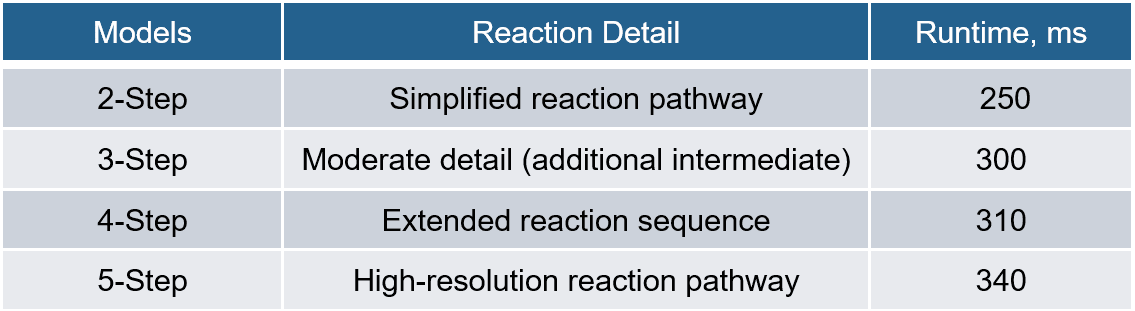
In addition to capturing the underlying physics, computational efficiency is key for practical use. As the model becomes more detailed, with more reaction steps and parameters that need to be calibrated, it still remains very fast. This can be seen when moving from simple two-step models to more detailed five-step representations.
The results shown here are based on representative discharge simulations under typical operating conditions. As summarized in Table 1, even when increasing the number of reaction steps and calibration parameters, the runtime grows only slightly, remaining within a few hundred milliseconds per simulation. This demonstrates that increasing model fidelity has only a minor impact on computational cost.
Experimental Validation at Multiple C-Rates
The predictive capability of any model depends on how well it matches real-world behavior. GT-AutoLionSulfur has been validated against experimental discharge data across multiple C-rates (0.2C, 0.5C, and 1C), as shown in Figure 1. It accurately reproduces key Li–S features, including:
The high-voltage plateau is associated with sulfur dissolution, as well as the low-voltage plateau associated with lithium sulfide formation. This agreement provides confidence that the model captures essential physics. Model parameters are directly linked to physical material properties, enabling systematic calibration using laboratory data.

Once calibrated, the model can be used to predict performance under new conditions, such as different temperatures, sulfur loadings, or operating profiles, reducing the need for extensive experimental testing.
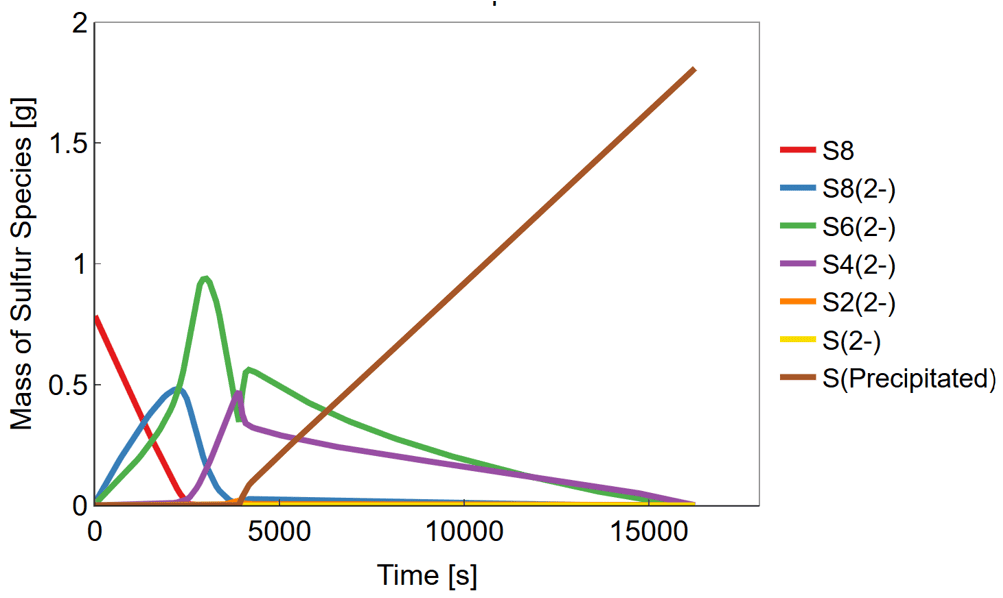
Beyond voltage prediction, GT-AutoLionSulfur also provides insight into the internal chemical evolution of the cell. The model tracks the mass of individual sulfur species throughout both charge and discharge, resolving the full reaction cascade from dissolved sulfur through intermediate polysulfides to final solid Li₂S precipitation, as illustrated in Figure 2.
This species-level visibility is a key strength of the framework, giving engineers deeper insight into how internal processes influence overall performance.
From Cell to Pack-Level Simulation
AutoLionSulfur is not limited to single-cell analysis. It can be extended to pack-level simulations and integrated into larger systems, as shown in Figure 3. Using the model, engineers can:
- Evaluate battery performance under realistic load profiles
- Simulate series and parallel pack configurations
- Analyze electrical interactions between cells
- Study system behavior across different operating conditions
By connecting cell-level physics with system-level performance, GT-AutoLionSulfur enables engineers to explore trade-offs and optimize designs before building physical prototypes.

Application Focus: UAV Mission-Level Simulation
Li-S batteries are particularly attractive for unmanned aerial vehicles (UAVs), where reducing battery weight directly translates into increased range, payload capacity, and flight endurance. However, UAVs rarely operate under constant conditions; real missions involve highly dynamic and time-varying power demands.
This is where GT-AutoLionSulfur provides a key advantage. By integrating system-level models in GT-SUITE, it enables engineers to simulate battery performance under realistic mission profiles, rather than simplified constant-current scenarios.
Figure 4 presents three representative UAV mission profiles, each with a distinct power demand pattern over time:
- Case (a): Variable load profile with distinct phases of high and low power demand
- Case (b): Step-like demand representing mission segments with sustained operating conditions
- Case (c): Highly dynamic pulsed load, representing aggressive or rapidly changing flight maneuvers

Using GT-AutoLionSulfur, engineers can simulate each mission scenario individually, size the battery accordingly, and understand how dynamic loads impact voltage limits and usable capacity. This enables more accurate design decisions and reduces reliance on costly physical prototyping, especially in early development stages.
The Role of Physics-Based Modeling in Li–S Battery Development
Li-S batteries offer exciting possibilities, but their complexity requires a deeper level of understanding than traditional battery chemistries. GT-AutoLionSulfur provides a practical way to bridge that gap by combining:
- Physical insight
- Computational efficiency
- Integration with system-level simulation
With the right modeling tools, engineers can accelerate development, reduce trial-and-error, and make more informed decisions as Li–S technology continues to evolve.
GT-AutoLionSulfur is available as part of the GT-AutoLion product family in V2027, shipping with a ready-to-run validated pouch cell example for immediate exploration.
To learn more about simulation-driven battery development, contact us and visit our Battery Simulation Solutions page to explore advanced battery modeling capabilities, read our previous blogs.
Subscribe to the GT blog for the latest insights on engineering simulation, battery innovation, and product updates, and follow us on LinkedIn to stay informed about the latest developments in simulation-driven engineering.