



Author: Ebin Mathew

|An innovative smart sensor box mounted on a sleek metal pole in a modern urban park

Part 2 — Modeling Physical Digital Twins: Battery Behavior and Aging with GT‑SUITE and GT‑AutoLion

In Part 1, we explored why solar-charged, battery-powered IoT monitoring devices require reliable prediction of availability, SOH, and RUL, and why telemetry, statistical methods, or machine learning alone are not sufficient. In this second part, we focus on the modeling foundation: how GT‑SUITE and GT‑AutoLion provide the physics‑based structure that allows each digital twin to […]


Read More
An innovative smart sensor box mounted on a sleek metal pole in a modern urban park

Part 1 — Exploring the Power of Physics-Based Digital Twins

From asset monitoring stations in remote locations to industrial sensors tracking equipment health, many modern systems rely on small, self-powered IoT devices operating far from human reach. These devices are typically equipped with a solar panel, a battery, and a communication module. Their job is simple: collect data, stay powered, and reliably transmit information to […]

Read More
||Illustration of modularity|Geometry conversion of original CAD|furnace

Model Predictive Control with NARX Metamodels: Smarter Torque Requests for Fuel Cell Vehicles

As electrification expands across commercial fleets, engineers are rethinking power management to deliver efficiency, drivability, and robustness under real‑world conditions. By anticipating what the vehicle will need moments ahead, Model Predictive Control (MPC) reduces energy waste, smooths transients, and keeps the power source operating in its most efficient window. MPC paired with a dynamic, data-driven […]

Read More
furnace

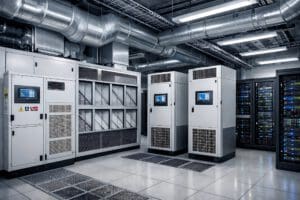
Modeling the Google Deschutes CDU in GT-SUITE: A Blueprint for Liquid Cooling Success

A Difficult Balance for Data Centers As data centers push toward higher rack power densities and rapidly scaling AI workloads, liquid cooling has become essential for managing extreme thermal loads efficiently. Designing these next generation cooling systems is challenging – engineers must balance reliability, energy use, water consumption, and safety, all while navigating tight deployment […]

Read More
Server room with cloud on ceiling modern technology data center concept|Futuristic wireless Smart BMS powered by AI

Transforming Data Center Cooling: From Physics-Based Simulation to AI-Powered Control

Data centers face an unprecedented thermal challenge that demands revolutionary approaches to cooling system design and control. As computational demands surge with AI workloads and high-performance computing applications, heat generation has increased dramatically with some next-generation systems producing heat fluxes many times higher than traditional data centers. This exponential growth in thermal loads is pushing […]

Read More
Futuristic wireless Smart BMS powered by AI

BMS Architecture Explained: How a BMS Protects, Balances & Optimizes Batteries

In the previous blog, we discussed how the underlying architecture of a battery management system (BMS) is very similar to our central nervous system. The BMS relies on sensors (sensory organs) to make real-time decisions to ensure safety and optimize performance of the battery pack. From a simulation perspective, this architecture provides the foundation for […]

Read More
Machine Deep learning algorithms

Combining Physics and Machine Learning to Predict Battery Aging with Confidence

Battery technology is evolving rapidly to meet the growing demands of electric vehicles, large-scale energy storage systems, and portable electronics. A major challenge lies in reliably predicting long-term battery performance within practical development timelines. Because batteries degrade gradually during both use and storage, conventional testing methods take a long time to produce accurate lifetime estimates. […]

Read More
Engineering Insights Blog|BMS|BMS|Tilt-Rotor Animation|Operational Window|VTOL|Simulation Result Summary Table|Flight Mission Profile|Simulation Results|Series Hybrid Tilt-Rotor Model Example in GT-SUITE|Comparison of steady and transient model response|IceFraction Animation|fuel cell bus|Schematic of water recirculation|System Workflow of a Series Hybrid Tilt-Rotor in GT-SUITE_01||Ice fraction near cathode catalyst layer||Routes Selected for System Level Simulation|2D flowfield in CAD

A Year of Engineering Insights: Our Top 7 Blogs You Shouldn’t Miss

From smarter thermal systems and next-generation batteries to digital twins, fuel cells, and advanced air mobility, we explored how engineering simulation is reshaping engineering decisions across industries. If you’re working at the intersection of innovation, performance, and efficiency, these seven blogs capture the most impactful ideas we shared in 2025, each addressing real-world engineering challenges […]

Read More
Virtual Calibration|BMS|BMS|Operational Window|Tilt-Rotor Animation|VTOL|Simulation Result Summary Table|Flight Mission Profile|Simulation Results|Series Hybrid Tilt-Rotor Model Example in GT-SUITE|IceFraction Animation|System Workflow of a Series Hybrid Tilt-Rotor in GT-SUITE_01|Comparison of steady and transient model response||fuel cell bus|Schematic of water recirculation|Ice fraction near cathode catalyst layer||Routes Selected for System Level Simulation|2D flowfield in CAD

Introduction to Virtual Calibration: A Smarter Approach to Powertrain Development

The Limitations of Conventional Calibration and Testing Testing and calibrating powertrains is crucial for product development yet traditionally requires years of work and millions in investment. Over time, requirements have expanded considerably to address regulatory compliance (OBD/emissions), customer expectations (efficiency), and manufacturer standards (reliability). Meeting these demands involves extensive physical testing through in-house facilities, on-road […]

Read More